
MVP Costs Dropped 20x. VCs Are Panicking. Solo Founders Are Winning.
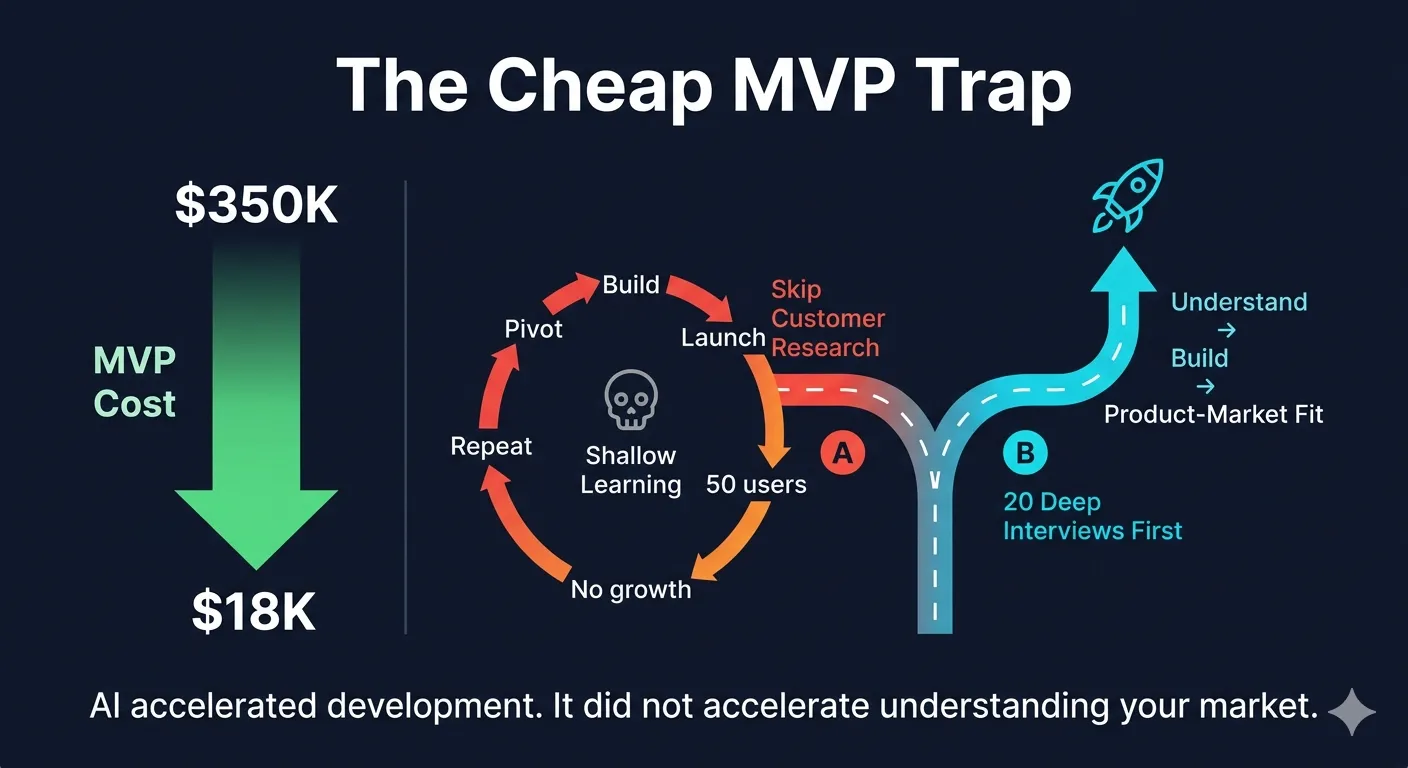
A VC fund just published their internal thesis. The punchline: building an MVP went from 350K to 18K. Their evaluation criteria changed overnight. A working product is no longer a competitive advantage. It’s a minimum requirement.
I read this and thought: finally, someone on the money side said the quiet part out loud.
The Pre-Seed Math That Broke Venture Capital
Roman Beloded from YellowRocks.vc laid out the shift in brutal detail.
Three years ago, an EdTech founder walked into their office asking for 500K. Planned to spend 350K on the MVP alone. Two backend devs, a frontend dev, a designer, a team lead. Six months to first version. They passed. The margin of safety was too thin.
In March 2026, a different founder showed up with a similar idea. He already had a working product. Built it himself with Cursor and Claude Code. Spent $18K over two months. Mostly API tokens, hosting, and some freelance design.
400 users were already paying.
That’s not a story about one smart founder. That’s a structural shift in how software gets built.
“If you don’t have a prototype in 2026, the question isn’t ‘what’s your timeline?’ It’s ‘what have you been doing?’”
💡 Unique Insight: The New Pre-Seed Baseline
Y Combinator’s W2025 batch had a record number of solo founders. Over a quarter of the cohort. Harry Tan said it directly: AI tools let one good engineer do what used to require ten. According to PitchBook data, the median pre-seed round in AI dropped from
2.5M to1.2M. Founders ask for less because they need less.
The Cheap MVP Paradox: More Products, Same Hit Rate
Here’s where it gets interesting. And here’s where most people reading the YellowRocks piece stop too early.
When MVP cost drops 20x, more products get built. But not more good products.
YellowRocks saw 40% more applications in their pipeline last year. Their conversion rate to actual deals stayed the same. The filter used to be “do you have a working product?” That filter stopped working.
I see this constantly. Founders who build three products in six months. Each time: MVP in three weeks, launch, 50 users, no growth, pivot. The cycle is fast. The learning is shallow. Because when you invest little, you lose little, and you learn little.
“AI accelerated development. It did not accelerate understanding your market.”
This is not a new problem. It’s the oldest problem in startups. Just faster now.
Twenty deep customer interviews still matter more than a perfect MVP. AI can’t do those for you. Not yet. Maybe not ever.
Where The Startup Moat Actually Moved
The YellowRocks team rewrote their internal evaluation criteria. Three changes stood out to me:
1. A working MVP is table stakes, not a bonus. If it’s 2026 and you show up without a prototype, investors won’t ask about your roadmap. They’ll wonder if you’re serious.
2. What AI can’t automate matters more than what it can. Deep understanding of your customer’s actual workday. The ability to sell manually, before you scale. Unique data that a competitor can’t get by writing a better prompt. Distribution channels that can’t be cloned.
3. Product sense replaced technical skill as the key founder trait. A CTO co-founder used to be almost mandatory. Now a founder with good prompt engineering and understanding of AI tools can cover the technical side at early stage. The value shifted to whoever understands the customer best and knows how to sell.
This lines up perfectly with what I’ve been building at QuotyAI. And it validates a bet I made over a year ago. If you’re looking to bootstrap your own startup, I wrote a practical guide on how I run this whole operation for $30/month.
💡 Unique Insight: The Thin Wrapper Graveyard
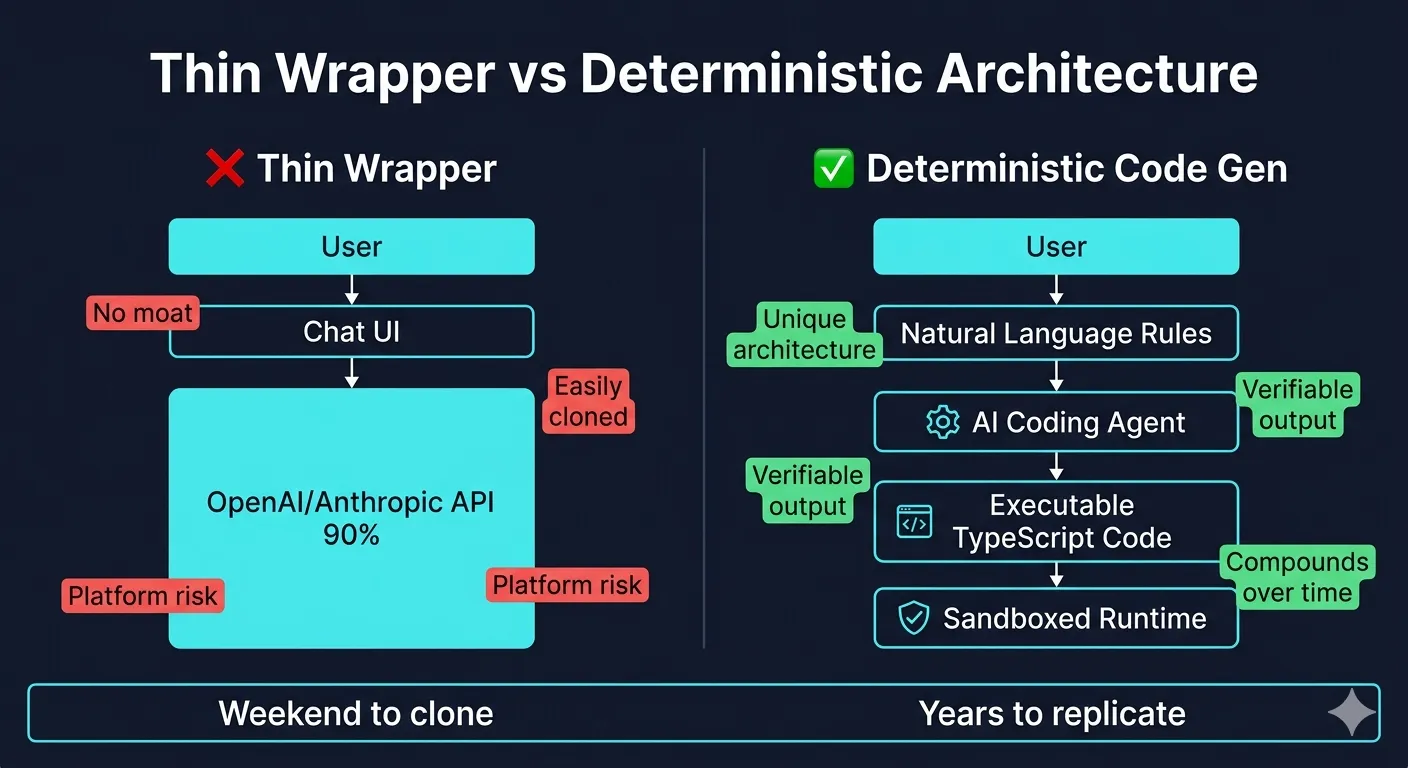
Analyst forecasts predict 90% of AI startups will fail. The main killer: the “thin wrapper” model. Take an OpenAI or Anthropic API, build a UI on top, call it a product. Within six months, dozens of competitors do the same thing, and the platform adds a native feature that kills every wrapper overnight. Craftly.ai learned this the hard way in the Shopify ecosystem by 2025.
The Base44 Case: One Developer, $80M, Six Months
The YellowRocks article cited one story that deserves its own section.
Maor Shlomo. 31 years old. Israeli developer. Built Base44 completely alone. Six months later: 250,000 users, 3.5M annual revenue. Wix acquired the company for 80M cash in June 2025.
One person. Zero ads. Zero marketers. Zero investors. He built in public, on social media, and the audience came to him.
Dario Amodei, CEO of Anthropic, predicted with 70-80% confidence: the first $1B company with a single employee will appear in 2026. Not in five years. This year.
The share of solo founders among new startups grew from 23.7% in 2019 to 36.3% in early 2026. For the first time in fifty years, more than a third of all startups are created by one person.
I’m one of them.
“Harry Tan, CEO of Y Combinator: ‘A quarter of startups in our current batch have 95% of their code written by AI.’ Not 10%. Not 30%. Ninety-five percent.”
Why Deterministic AI Isn’t a Thin Wrapper
Let me tell you why I read the YellowRocks piece and felt validated, not threatened.
QuotyAI is not a wrapper around GPT. It’s not a chat UI on top of an API. I laid out this architecture in detail in my post on the deterministic bet.
When you tell QuotyAI your business rules, it doesn’t save them as text in a vector database. It generates executable TypeScript code. Pricing formulas. Order validation. Scheduling logic. It runs that code deterministically, every single time.
function calculatePrice(nights: number, isRepeatGuest: boolean): number {
  const base = nights * 50;
  const cleaning = 20;
  const loyaltyDiscount = isRepeatGuest ? 0.1 : 0;
  return (base + cleaning) * (1 - loyaltyDiscount);
}
No hallucinations. No “probably correct” answers. Math. Correct math.
That’s not something you replicate by prompting GPT differently. That’s architecture. That’s a bet on how AI should work for business, not just how it should talk.
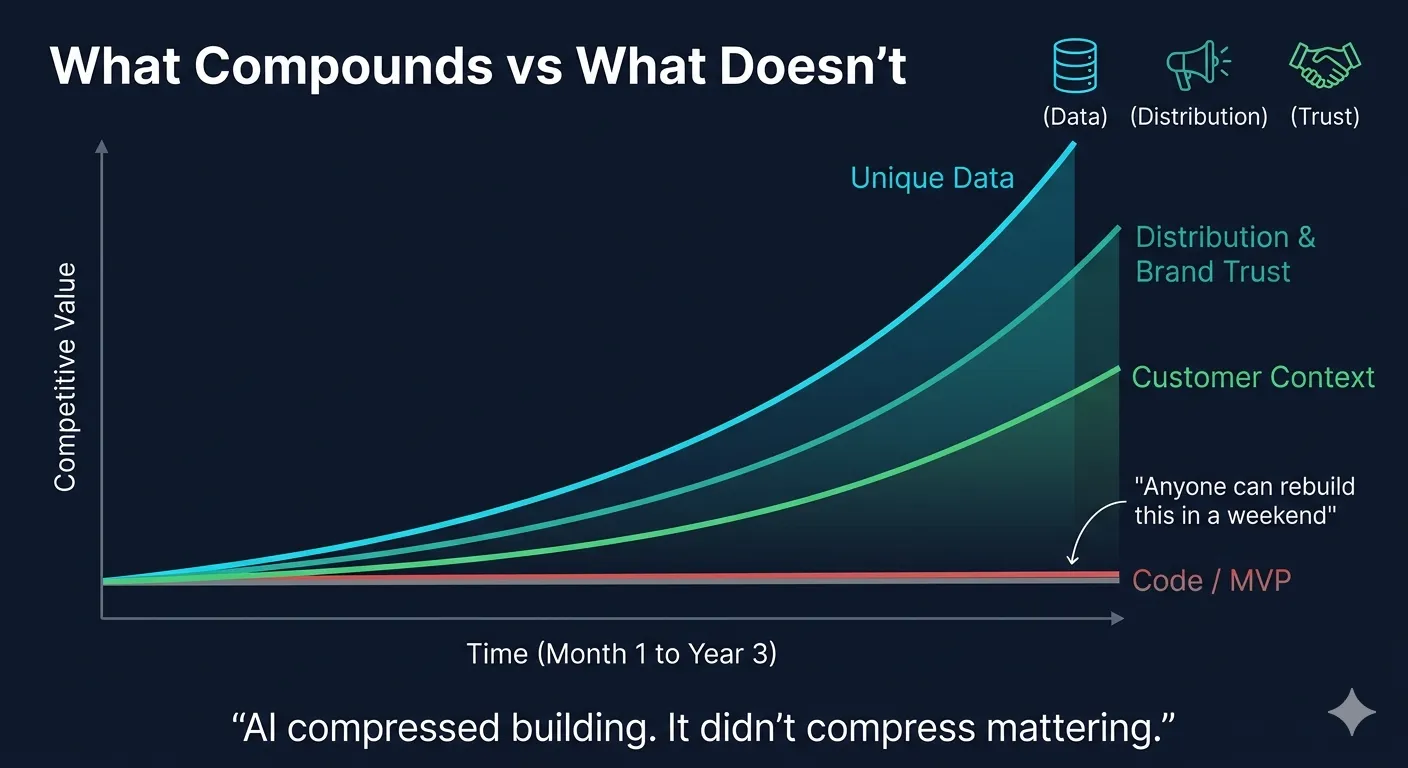
“The moat in 2026 is not your code. It’s your context, your data, and your customer’s trust. Code is just the delivery mechanism.”
💡 Unique Insight: Context Is The New Code
When a product understands your user’s world better than every alternative, switching feels like starting over from zero. That kind of understanding can’t be built in three weeks. It takes months of interaction with real customers. It’s the only moat that gets stronger with time and can’t be compressed by AI.
What Solo Founders Should Actually Do Right Now
If you’re a solo founder reading this, here’s what I took from the YellowRocks thesis. Filtered through two years of building QuotyAI from a laptop in Vietnam.
Stop celebrating cheap MVPs. The celebration ended. Now it’s the baseline. If your entire pitch is “I built a thing,” you’re already behind.
Start with the customer, not the code. AI made it trivially easy to build. It did not make it easier to understand who needs what you’re building. Do the 20 interviews. Do them before you write a single line.
Build things that accumulate. Content libraries. Training data from real conversations. Domain expertise baked into your product’s logic. SEO authority. Brand trust. These compound. Code doesn’t. I covered how to build domain-specific AI solutions for homestays, restaurants, real estate, and more on our industry solutions page. We also built an accounting module that does the same deterministic work for receipts and expense tracking.
Don’t be a wrapper. If someone can replicate your product by changing the system prompt, you don’t have a product. You have a demo. The gap between a weekend hackathon demo and a reliable business tool is 10x to 100x larger than most founders expect.
Own your distribution. The YellowRocks team now evaluates distribution channels that can’t be copied. If your growth depends entirely on a platform you don’t control, you’re one algorithm change away from zero.
“A VC fund rewrote their playbook. Not because AI changed what good looks like. Because AI made ‘good enough’ free.”
AI Compressed Building. It Didn’t Compress Mattering.
There’s a line from the YellowRocks piece that stuck with me. They talked about FitStars, a fitness platform they’d built over six years. Today, someone could rebuild the product in a month. But the audience, the content library with thousands of workouts, the trainer brands, the years of SEO work? That took years. It doesn’t clone through AI.
That’s the real lesson.
AI compressed the cost of building. It did not compress the cost of mattering.
The three things that matter now: unique data, strong distribution, and audience trust. All three require time. Time that no AI can shrink.
I’m building QuotyAI with this in mind. Every conversation my AI handles generates structured data. Every business rule becomes executable code. Every customer interaction deepens the product’s understanding of that specific business. That context accumulates. It compounds. And it can’t be replicated by spinning up a new wrapper over the weekend.
That’s the bet. Not on cheaper code. On deeper context.
I’m building this in public. Every mistake. Every win. Every deployment from a coffee shop in Dalat.
What’s your moat? Is it code someone can rebuild in a weekend? Or is it something that compounds?
References
[1] YellowRocks.vc - Original analysis on MVP cost reduction [2] PitchBook - Q1 2026 Pre-Seed Data [3] Y Combinator - W2025 Batch Statistics [4] Cognition Labs - Devin AI Developer Performance Data [5] TypeScript Documentation - Type Safety
Frequently Asked Questions
Q: Why do cheap MVPs create problems for founders? A: When building is nearly free, the temptation is to skip customer research and “just ship.” This produces more products but not better ones. Founders iterate fast but learn shallow, cycling through launches without deeply understanding their market.
Q: What replaced technical ability as the key founder skill in 2026? A: Product sense and customer understanding. A founder with strong prompt engineering skills can handle early-stage technical work. The scarce skill is knowing exactly what to build and for whom, then selling it manually before scaling.
Q: How does QuotyAI avoid being a “thin wrapper” AI startup? A: QuotyAI generates executable TypeScript business logic from natural language rules, not just chat responses. This deterministic architecture means pricing, scheduling, and order validation are mathematically correct every time. That’s a fundamentally different approach from wrapping an LLM API with a UI.
Q: What makes a real moat in the AI era? A: Three things: unique data that competitors can’t get by writing a prompt, distribution channels that can’t be cloned, and audience trust built over time. All three require sustained effort that AI can’t compress.