
It’s 7:30 AM. I’m sitting on a wooden balcony. Mist rolls over the pine trees. I’ve already deployed three times this morning.
Most people imagine digital nomads working from beach clubs, drinking coconut water, posting Instagram stories between swims. This is not that.
This is how you build a real startup from the mountains. Not how you pretend to work while traveling.
The Da Lat Experiment
I didn’t come to Da Lat for startup culture. I was traveling, met my girlfriend, and decided to stay.
At 1500m elevation, Da Lat has perfect 22°C weather half the year, cool rain the other half. No humidity. No random Bali-style afternoon downpours. Consistent rain you plan around.
No beach clubs. No influencer meetups. Just pine trees, incredible coffee shops serving every variety: egg coffee, strong Vietnamese coffee with condensed milk, cold brew, pour over, and quiet. Nothing like Bali or Singapore.
This isn’t about productivity hacks. It’s about environment design. Most nomads choose environments that fight focus. I chose one that enables it.
💡 INSIGHT: The most impactful productivity decision you can make is not what app you use, but where you choose to live. Environment determines 80% of your focus before you even open your laptop.
I don’t use co-working spaces. I work from my living room, balcony, or one of the quiet local coffee shops. 300Mbps fiber internet never goes down. It costs $12/month. This is faster and more reliable than most internet in Western countries, as documented in the Vietnam Broadband Report 2025.
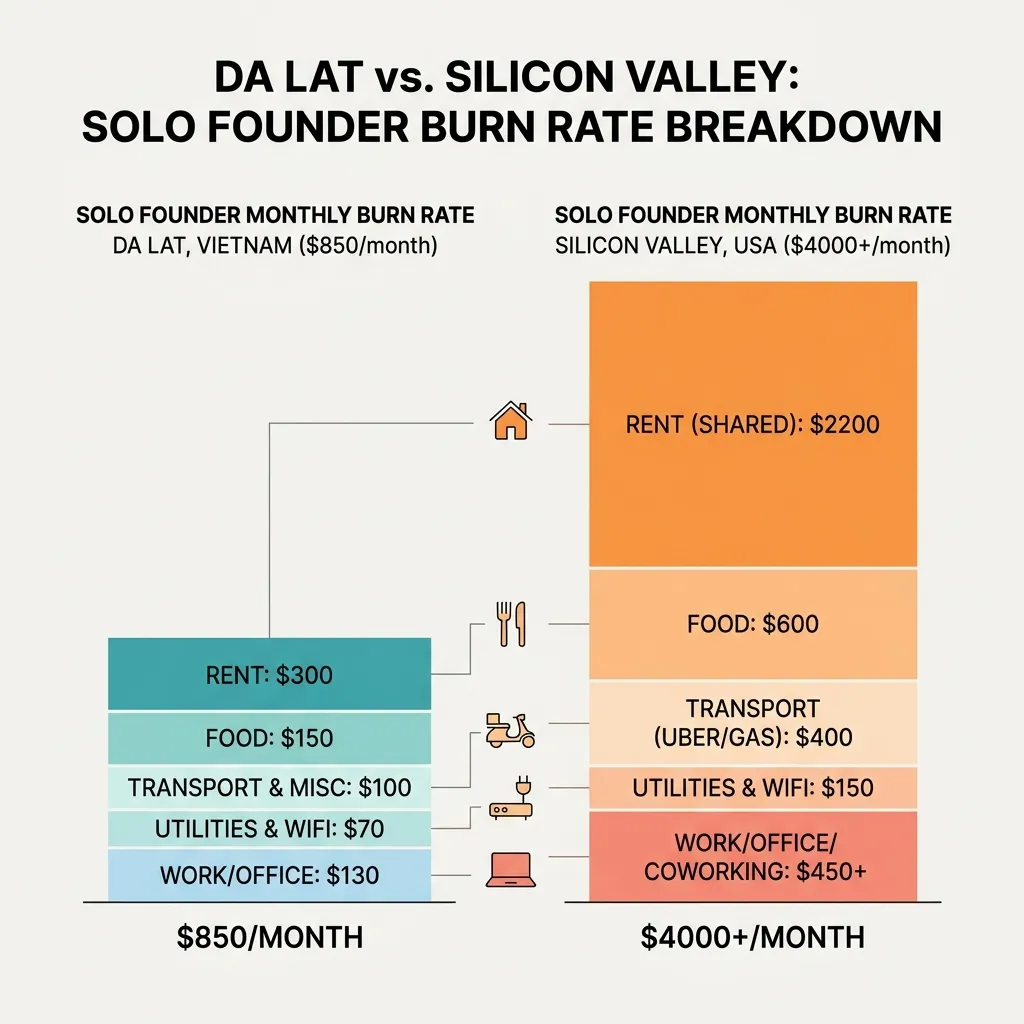
Total monthly living cost: $850. That covers a 3-floor house ($500/month - one floor for our yoga studio, first floor planned as a coffee shop), eating out for every meal, internet, twice-weekly cleaning, and a girlfriend who knows every good coffee shop within 10km.
The food here is perfect, impossibly affordable, and one of the main reasons we stay: banh bao for breakfast ($0.50), pho bo ($1), banh mi ($0.75), com tam for lunch ($1.50), bun bo Hue, banh xeo, and nhau street food dinners with cold beer for $3 total. You can eat like a king every day for under $6.
At $850/month burn rate, you don’t need VC. You don’t need to raise money. You don’t need to perform. You just need to build something people will pay for.
Remove the pressure, and you can actually build something good.
The Actual Setup
People ask about my setup expecting fancy gear. It’s boring.
14-inch Lenovo laptop. No mouse. No external monitor. $15 desk from the local market. That’s it.
“The best equipment is the equipment you already have. Everything else is just theater.”
The rules that actually matter:
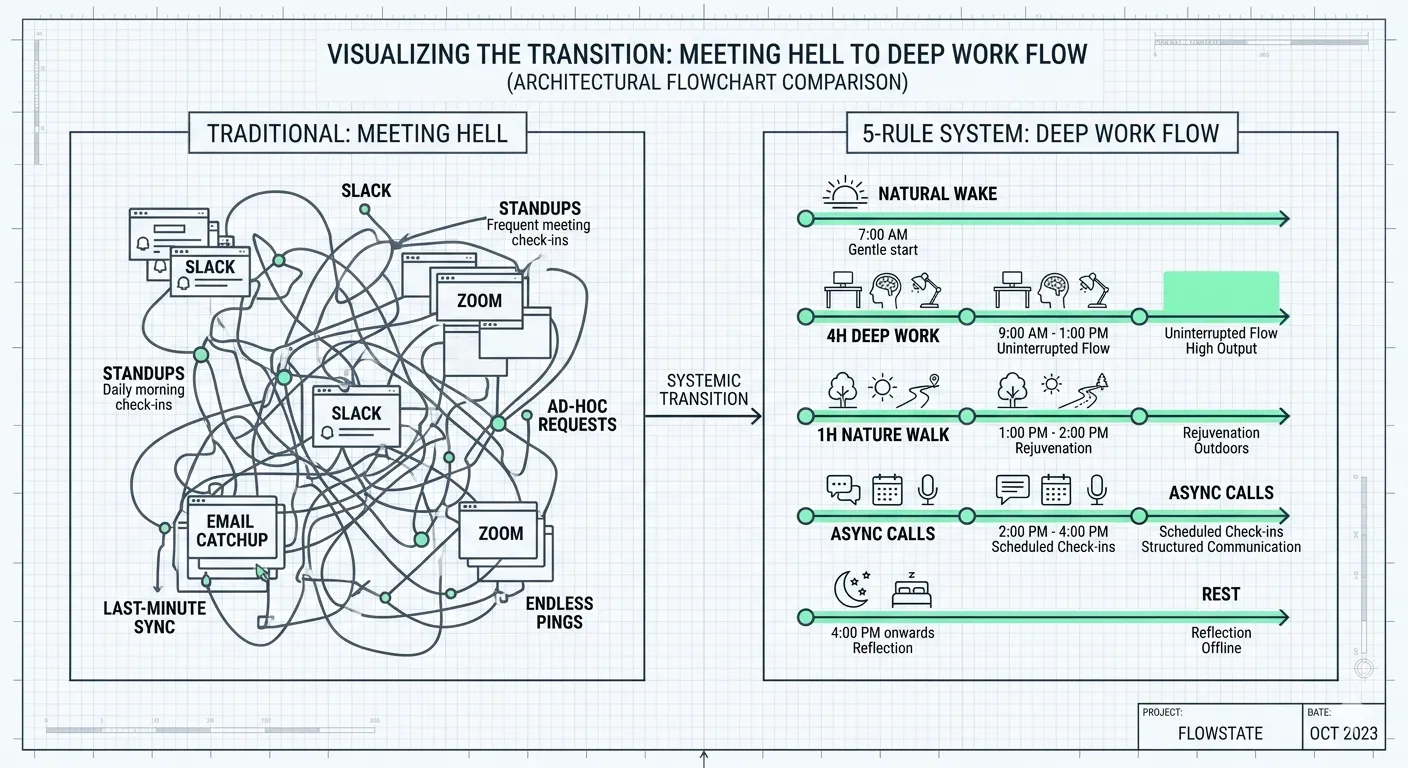
- Wake up when I want. No alarm. No routine. 6 AM some days, 9 AM others.
- Spend 4 hours designing, verifying, correcting, testing, and deciding what and how to build. 99% of the time I use coding agents now—I almost never write code myself. This aligns perfectly with the modern solo founder approach described in the Software 2.0 thesis.
- Walk for 1-3 hours when stuck.
- Take customer calls when convenient.
- Stop working entirely when tired.
That’s the entire system.
💡 INSIGHT: Productivity is not about working more hours. It’s about working only when your brain is actually capable of making good decisions. Everything else is just busywork.
Before this, I worked 12-hour days, checked Slack at 10 PM, was always exhausted, and shipped half as much.
Now I work when I’m not with my girlfriend—sometimes 2 hours, sometimes 10. I ship far more. I sleep 8 hours. I hike. I drink incredible coffee every day. We drive a scooter everywhere—driving in Vietnam is quite dangerous, but you get used to it. We go to the beach in Nha Trang or Phan Rang once every 2 weeks. I’m happier.
This isn’t about working less. It’s about working when your brain actually works.
Most founders bragging about 16-hour days are lying. 6 hours scrolling Twitter, 4 in useless meetings, 2 pretending to work while waiting for CI.
I deploy in 90 seconds. No meetings. No employees. No alignment required. All I do is make good decisions.
That’s the solo founder superpower: no theater of busyness. Just work.
Enterprise Habits Worth Keeping
I didn’t abandon everything I learned from 10 years in enterprise architecture—just the stupid parts.
I still use CI/CD. I still monitor everything with OpenTelemetry. I still write maintainable TypeScript.
But no Kubernetes. No microservices. No two-week architecture reviews. Everything runs on a $15 GCP VM.
You don’t need a $300 chair, $1000 monitor, fancy co-working membership, or Silicon Valley address.
“You need quiet. You need good internet. You need to stop caring what everyone else thinks you should be doing.”
You need quiet. You need good internet. You need to stop caring what everyone else thinks you should be doing.
Most startups fail not for bad ideas, but because founders are too busy performing startup life to build the product.
Too busy posting on Twitter, attending conferences, networking, raising money. Never actually building what people want.
In Da Lat, there’s no audience to perform for. Just you, the pine trees, and good decisions.
💡 INSIGHT: When there’s no one around to impress, you stop performing and start building. That’s when real progress happens.
The New Normal
This isn’t temporary. I’m not “taking a break” before moving to a big city.
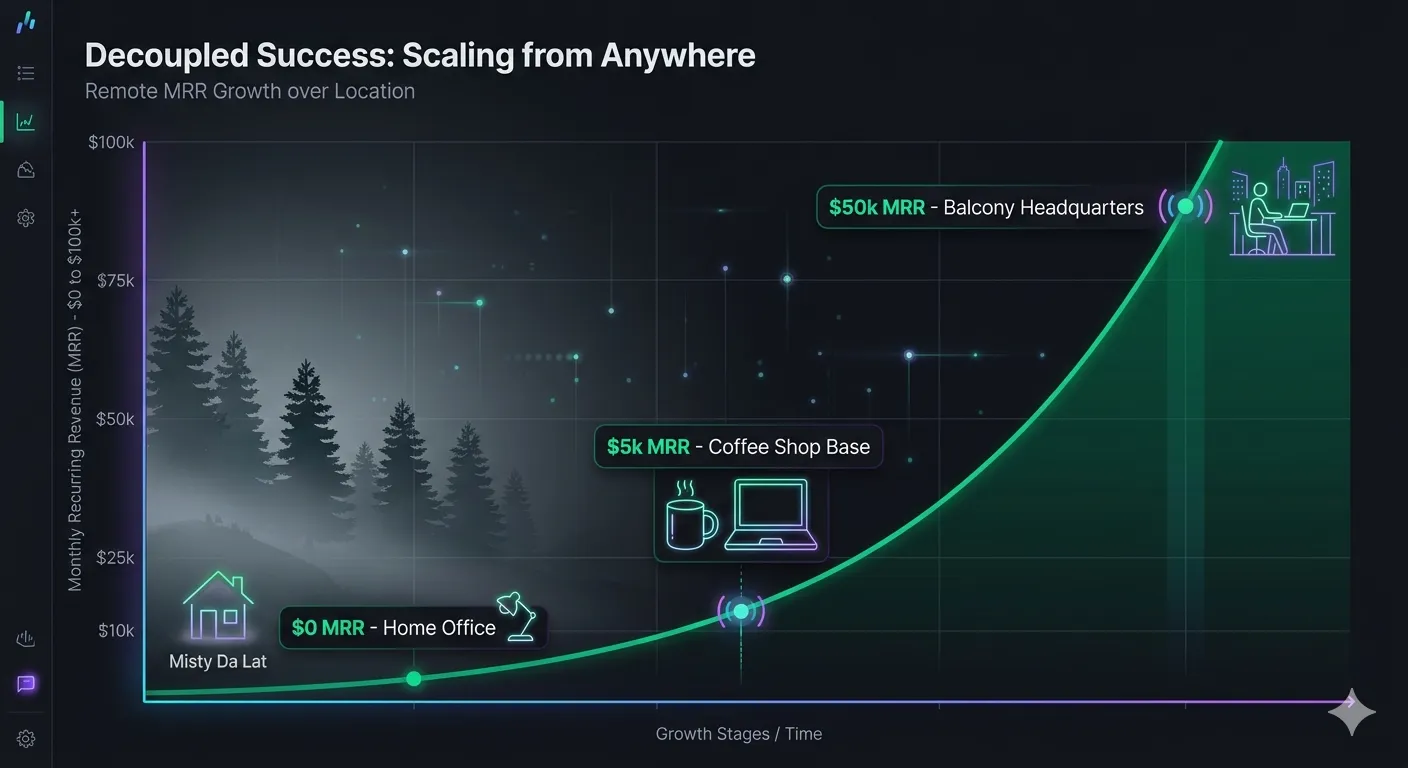
I’m building QuotyAI from this balcony. I’ll hit $10k MRR here. $100k MRR here. No one will care where I am. Customers won’t care. Code won’t care.
The internet changed everything 20 years ago, but most founders still follow old rules: specific city, team, funding.
You don’t.
You can build a multimillion-dollar business alone from Vietnam’s mountains, 12 time zones from your customers, hiking every afternoon. This is exactly what the future of work reports have been predicting for years, but few founders actually take advantage of it.
I’m building QuotyAI in public. Every deployment, every mistake, every win. All from this wooden balcony.
Will the rest of the startup world realize you don’t need a $4000 San Francisco studio to build something great?
Frequently Asked Questions
How much does it cost to live and work in Da Lat as a digital nomad?
You can live comfortably in Da Lat for $850/month total, including a 3-floor house, 300Mbps fiber internet, eating out for every meal, twice-weekly cleaning, and transportation.
What equipment do you need for a productive nomad setup?
All you need is a laptop, $15 local desk, and reliable internet. No external monitors, fancy chairs, or co-working spaces required for maximum productivity.
Can you build a successful startup without VC funding?
Yes. With $850/month burn rate, you don’t need VC funding. You can build and scale a profitable startup by focusing on customer value instead of startup theater and performance.
Is the internet reliable enough for remote work in Da Lat?
300Mbps fiber internet costs $12/month and never goes down. It’s more reliable than most residential internet connections in the US and Europe.
What about time zone differences with customers?
12 time zones from customers means I can work on the product while they sleep, and they wake up to new features deployed. It creates a natural asynchronous workflow that eliminates real-time meetings.