
QuotyAI's First Mission: Two Small Businesses, Two Problems
An early pilot brief for a homestay and a restaurant, with explicit targets for inquiry coverage, time saved, and fewer no-shows—not measured results.
Everyone builds products for “the market.”
They talk about TAM, SAM, and SOM. They make personas. They interview 50 people and build something slightly useful for 1,000 people, but not life-changing for anyone.
I wanted to do the opposite: understand two real businesses deeply enough to solve their expensive, boring problems.
Update, November 24, 2026: This post was first published on April 10, 2026. I have removed customer names and identifying details. The original brief described two pilot businesses, but the repository does not contain audited outcomes or proof of current production use. Treat the figures below as owner-reported context, targets, or illustrative estimates—not case-study results.
Two businesses. Two problems. That was the scope.
The First Business: A Small Homestay Near Da Lat
The owner runs a two-room homestay in the highlands. In the April 2026 brief, she described a routine like this:
- Wake up at 6 a.m.
- Check Facebook Messenger, Instagram, WhatsApp, and booking-platform dashboards
- Answer the same questions about parking, early check-in, long-stay discounts, and capacity
- Miss messages while cleaning
- Lose occasional bookings after slow replies
- Spend an estimated three hours a day on messaging and coordination
Those are her self-reported estimates from April 2026, not measurements taken by QuotyAI. They describe a problem worth testing, not a baseline dataset.
The harder issues were consistency:
- Discounts depended on who asked and when.
- Guest counts were not always checked against the booking.
- Foreign-language messages sometimes needed family help.
PMS platforms can be complicated. Generic chatbots can invent prices. The opportunity was not “another chat interface.” It was a small-business workflow that knew the rules and escalated uncertainty.
What the Pilot Should Do
- Bring supported messaging channels into one inbox.
- Draft answers from the owner’s approved facts and policies.
- Use executable rules for prices such as “$25 on weekdays, $35 on weekends, 10% off over five nights, no discount in December.”
- Ask for clarification when a fact is missing instead of inventing one.
- Hand the conversation to the owner when confidence is low or the decision has money or policy consequences.
The owner still reviews the generated rules. When she says “15% off for stays longer than seven nights,” the intended flow is: extract the fact, generate and validate the rule, test it, then publish an approved version. The language model can still extract the rule incorrectly; review is part of the product.
QuotyAI’s current repository does not show native Booking.com or Agoda inbox integrations. Those dashboards remain manual unless a custom integration is built.
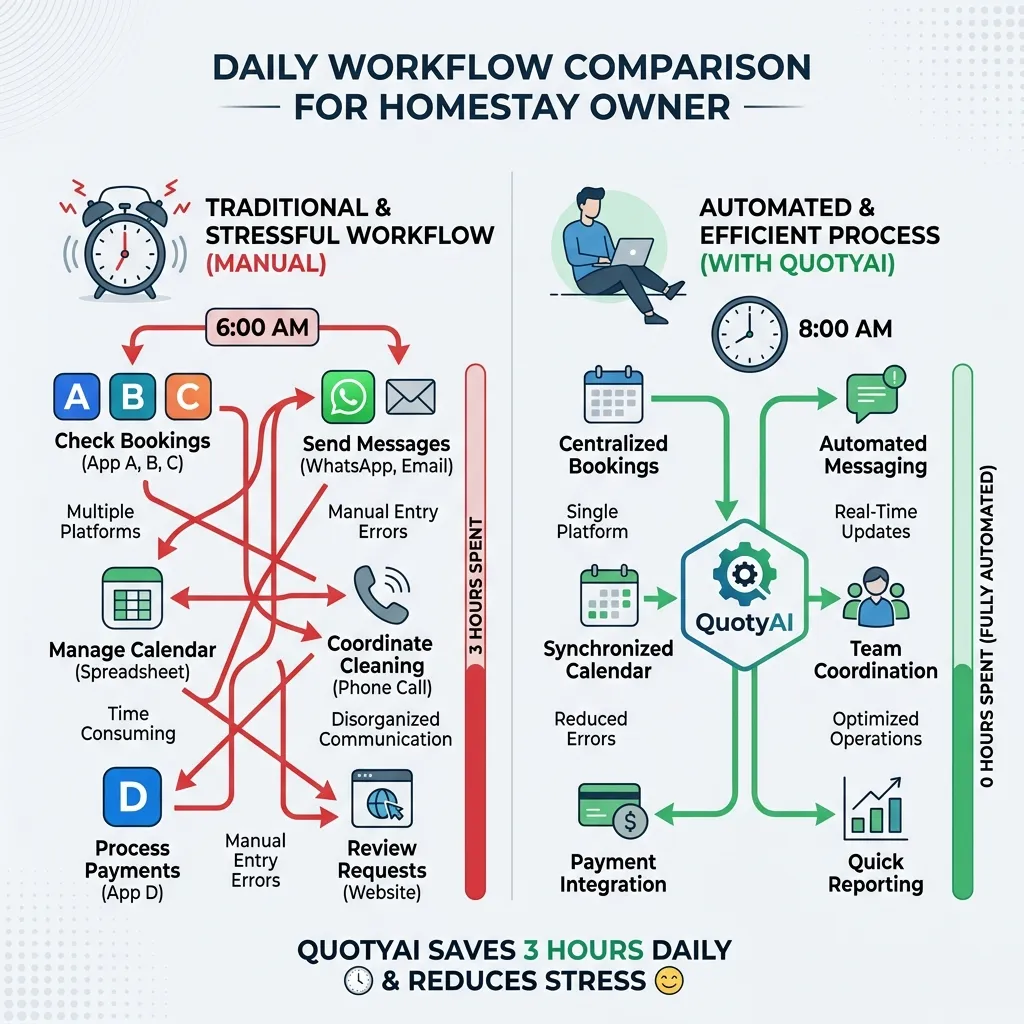
Original concept art. “Saves 3 hours daily” and “0 hours spent” are targets, not measured outcomes. Centralized OTA bookings and payment integrations are not all present in the current repository.
The product is not the AI. The product is time returned to someone who needs it—if the measurement proves it.
The Second Business: A Restaurant in Ho Chi Minh City
The owner runs a small craft-beer restaurant. In the April 2026 brief, he reported:
- About 10 reservation requests a day, mostly through Instagram
- An estimated 30% no-show rate
- Some groups arriving larger than their booking
- Messages sent late at night that were not seen until morning
- About $300/month spent on someone to reply to Instagram
These figures are self-reported and undated beyond the original April 2026 brief. I am keeping them as problem context, not verified business metrics.
I removed the claim that no-shows cost the restaurant industry $35 billion annually. The linked National Restaurant Association report did not substantiate that figure.
What the Pilot Should Test
The useful workflow is not “send a robot voice note.” It is a complete confirmation loop:
- Reply to reservation requests on supported channels.
- Confirm time, party size, and special requirements.
- Ask for contact details with a clear purpose and retention policy.
- Send an owner-approved reminder through an available messaging channel.
- Escalate non-responses according to a policy the owner has approved.
- Record attendance outcomes so the no-show rate can actually be measured.
A personal voice reminder was part of the original concept. The public site advertises LiveKit voice and the frontend includes a LiveKit client dependency, but I found no backend LiveKit service or scheduled voice-note reminder workflow in this checkout. That would require additional integration, consent handling, and testing.
Automatic cancellation and customer blacklists also need explicit policies. A missed reply is not always a no-show, and a blanket ban can create fairness and privacy problems. Start with a human-approved exception path.
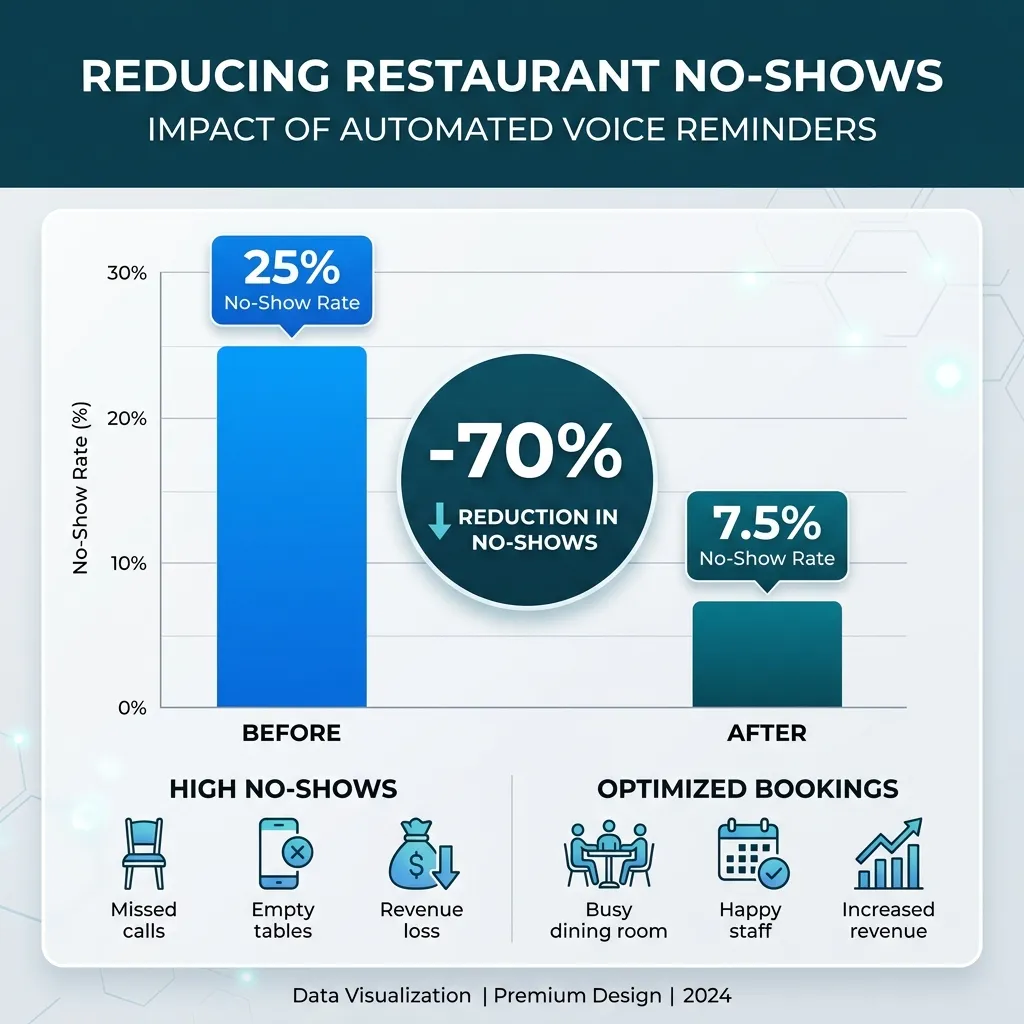
Original concept graphic from 2024. The 25% → 7.5% series and the “-70%” label are illustrative, not evidence of a deployed pilot.
Targets Are Not Results
Here is the honest scorecard for the first mission:
| Original promise | Correct label | What evidence would be needed |
|---|---|---|
| Handle 95% of inquiries | Initial test-set target | A fixed set of real, anonymized inquiries with approved answers; report coverage and errors separately |
| Save 3 hours/day | Owner-informed target | Time diary before and after, over a defined period, with the same workload |
| Reduce no-shows by 70% | Pilot target | Baseline and follow-up no-show rate using the same booking definition and sample period |
| Add $3,000/month | Illustrative estimate | Recovered covers × average check, minus discounts, fees, and variable costs |
| 100% accurate responses | Not a supportable end-to-end claim | Measure intent accuracy, rule correctness, delivery success, and human corrections separately |
The $3,000 figure cannot be validated without the restaurant’s average check, covers, baseline no-shows, and costs. I am not turning it into a forecast.
A 95% target is also not the same as 95% production accuracy. A curated test set can miss the messy traffic that arrives at 10 p.m.
What Counts as Production
The original headline said, “This is not a demo. This is production.” I cannot support that claim from the repository alone.
The public site also lists website-widget and LiveKit voice pages, while the frontend includes a LiveKit client dependency; I could not confirm native backend implementations for those in this checkout. What the repository does contain:
- Messaging-channel implementations
- A business-fact and schema pipeline
- Schema-derived TypeScript types and generated JavaScript pricing, scheduling, and validation functions
- Versioned releases and restricted
vmexecution with a timeout; Node’svmis not a complete security boundary - Human handoff and conversation history
Code existence is not proof of a live customer deployment, measured reliability, or business impact. Those claims need deployment records, incident history, and customer-approved outcome data.
The standard should be simple: can the owner run a normal day without holding their breath? Can they see why the assistant answered? Can they correct it? Can a person take over before a mistake becomes expensive?
Why This Still Matters
Most AI products optimize for a convincing conversation. Small businesses need the boring things to work:
- The right price
- The right availability
- The right guest count
- A clear escalation path
- A record of what happened
Language understanding will sometimes fail. Integrations will sometimes fail. For a pure function, deterministic execution means the same input, code version, dependencies, and runtime environment produce the same calculation—not that the entire customer experience is infallible.
The mission is to make failures visible, recoverable, and rare enough for the workflow to be useful. That is a better goal than “100% perfect.”
I am building this in public. If you run a homestay or restaurant, the current plans are on the homepage.
Pricing note, November 24, 2026: The public homepage advertises the BYOK and Standard offers above. Confirm them at signup. Local repository source docs/plans/subscriptions-llm-quota.md checked 2026-11-24 describes a different billing-plan model, so the public offer and implementation still need reconciliation.
Sources
- Node.js
vmDocumentation and Security Warning - QuotyAI Product Overview
- QuotyAI Shared Inbox
- QuotyAI Pricing Section
- WhatsApp Business Platform Messaging Rules
Frequently Asked Questions
What makes QuotyAI different from other chatbots?
QuotyAI separates language understanding from rule execution. Its repository includes a pipeline that generates schemas and TypeScript types, versions JavaScript rule functions, and runs them in a restricted Node vm context with a timeout. A pure calculation repeats for the same input, code version, dependencies, and runtime environment, but Node’s vm is not a complete security boundary; the language model can still misunderstand a rule and integrations can fail.
How much time does QuotyAI save small business owners?
Three hours per day was an initial target based on the homestay owner’s April 2026 estimate, not a measured result. A valid claim would require a time diary or comparable before-and-after measurement over a defined period.
What results does QuotyAI deliver for restaurants?
A 70% reduction in no-shows was a pilot target, not an observed outcome. The original $3,000/month figure was an illustrative revenue estimate without enough baseline data to validate it. No audited restaurant result is available in the repository.
What platforms does QuotyAI support?
The current backend repository contains native adapters for Facebook Messenger, Instagram, WhatsApp, Telegram, and a Chatwoot bridge. The public site also advertises a website widget and LiveKit voice, and the frontend includes a LiveKit client, but I could not confirm native backend implementations for those in this checkout. Booking.com and Agoda are not native inbox integrations in the current repository.
How does QuotyAI handle languages I don’t speak?
The assistant can be configured with languages and can draft multilingual replies, but translation and understanding can still be wrong. Review high-stakes wording, names, prices, and policies, and keep a human handoff path.
What does QuotyAI cost?
As shown on the QuotyAI homepage on November 24, 2026, the BYOK plan is free with up to 100 quotes per month and requires your own model key; the Standard plan is $79/month with hosted models and higher usage limits. Confirm the offer at signup: the public pricing copy and the local billing implementation are not fully aligned.
Related articles
Open Knowledge Format (OKF) vs Agent Skills
OKF organizes portable knowledge; Agent Skills package on-demand procedures and optional code. Here is where each fits — and when to query live systems instead.
Read articleDeterminism as Infrastructure
Why reliable AI agents need deterministic runtimes, explicit contracts, and verifiable completion—not just smarter models.
Read articleCheap MVPs Changed the Bar. Distribution Still Wins.
AI has made prototypes cheaper. The durable advantage is customer understanding, proprietary context, distribution, and trust—not the first working demo.
Read article