
OpenWiki vs QuotyAI: Reference Documentation vs Executable Business Logic
OpenWiki maintains evidence-backed Markdown for coding agents. QuotyAI builds tested, versioned business logic. Both use the LangChain ecosystem, but their runtimes and risk models differ.
OpenWiki writes and maintains documentation that coding agents can use. QuotyAI builds business artifacts that a sales assistant can execute. One produces context. The other can produce a quote.
That difference sounds simple. It changes almost everything: how the output is verified, where it lives, what a failure costs, and how you roll it back.
Update note — November 24, 2026: The original article said both projects used
createDeepAgent. That was true of QuotyAI’s July 2026 design. It is not true of the current repository. OpenWiki’s native CLI still uses DeepAgents; QuotyAI now uses LangChaincreateAgentand LangGraph.
OpenWiki: A Living Wiki With Source Evidence
OpenWiki is an MIT-licensed CLI. Its current README describes two modes: repository documentation in openwiki/, and a personal wiki from connected sources.
The interesting part is not “the agent writes Markdown.” It is the maintenance model:
- Pages are linked and searchable through local, read-only tools.
- Grounded Claims connect facts to versioned source evidence.
- Completed pages survive interrupted runs.
- A clean update can skip model work instead of rewriting everything.
- The output can be exported as Open Knowledge Format bundles.
A scheduled CI job can open a docs PR when the wiki changes. That gives OpenWiki a familiar developer safety net: inspect the diff, review it, merge or reject it.
The standalone CLI still uses DeepAgents and supports fifteen model providers. Coding-agent integrations can instead use the host agent’s authenticated session. Those are different execution paths, and the provider list applies to the standalone CLI.
OpenWiki’s output does not run as application code. A coding agent reads it as context. That does not make stale documentation harmless; it means the failure usually surfaces as a confused developer or a wrong code change, not an incorrect customer charge.
QuotyAI: Versioned Business Artifacts
QuotyAI solves a different problem. When a customer asks for a total, the answer must come from the business’s current rules.
The current builder has five skills:
aiPersona
catalog
dataCollector
checkout
agentPlugins
The artifacts are concrete:
- Catalog schema and data.
- Order, conversation, and contact schemas.
- Pricing, validation, and availability scripts.
- Plugin hooks.
- A checkout test suite and schema migration registry.
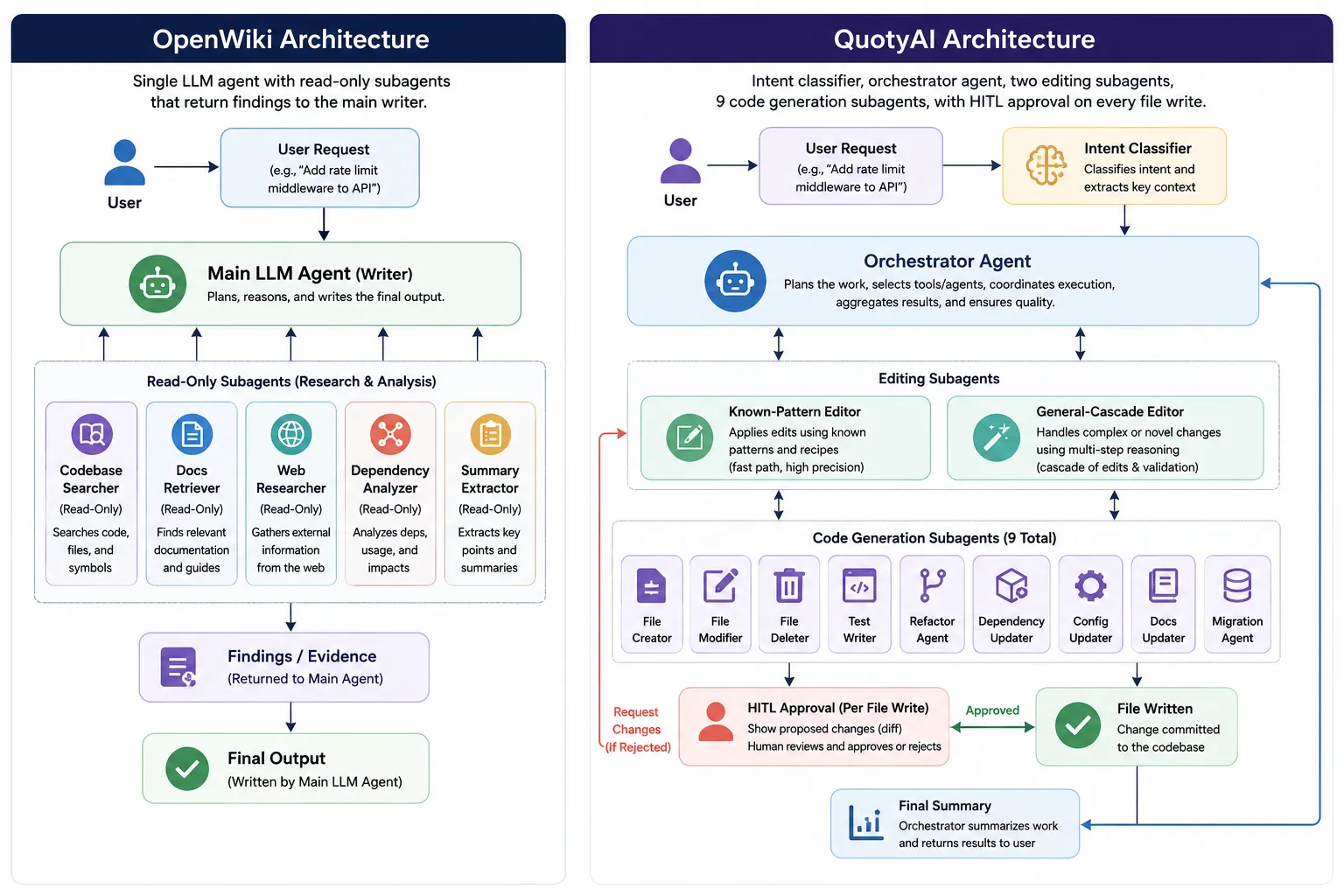
The skill definition catalog declares dependencies and writable paths. The builder uses LangChain createAgent; a LangGraph StateGraph routes among 15 specialist roles.
A draft lives in a thread workspace. A commit creates a versioned release in In Development. Publishing moves the live environment forward. Rollback moves it back. Those are separate operations because generation and customer impact are separate risks.
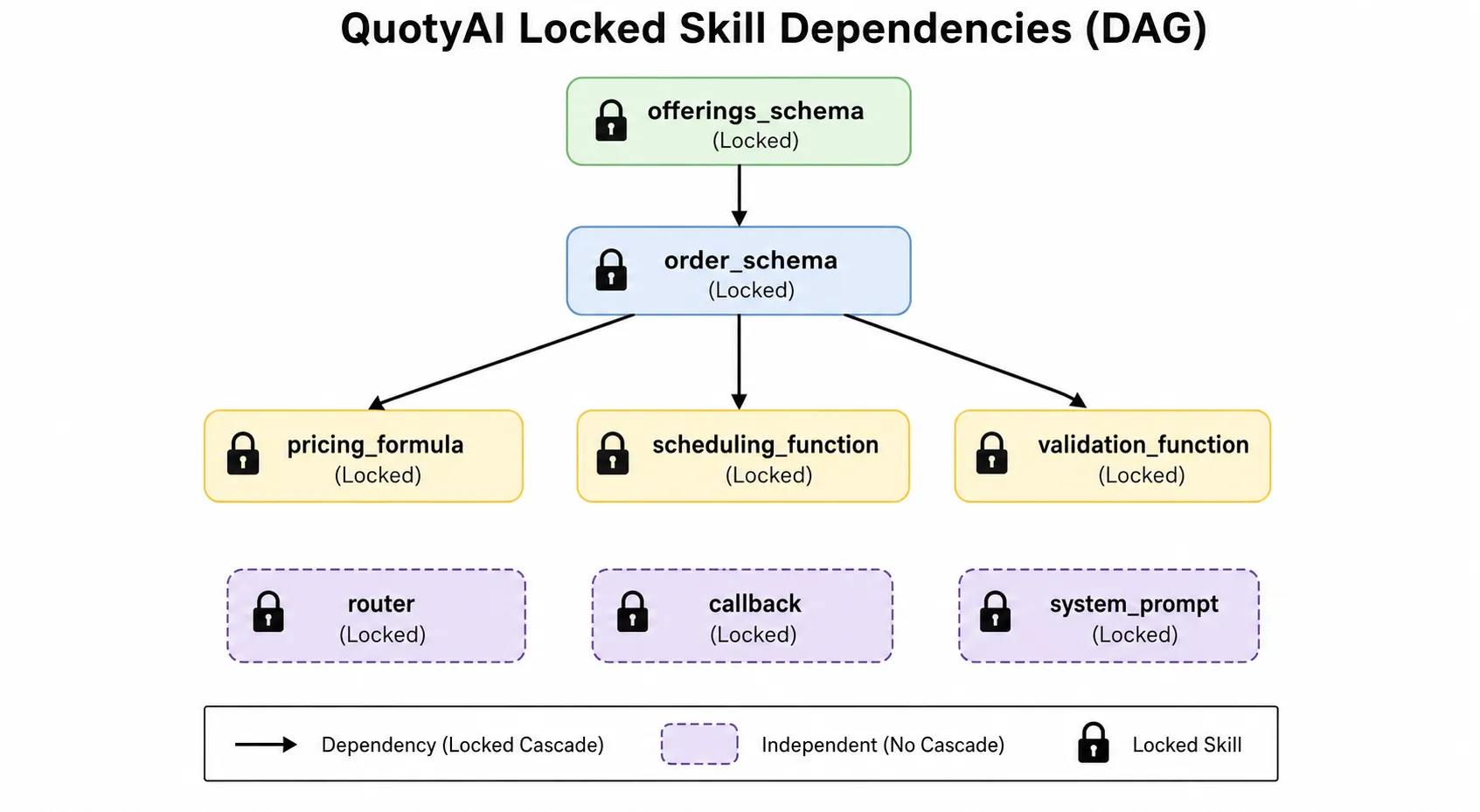
Historical diagram from the July 2026 five-resource cascade. The current five-skill dependency graph is described below.
Where the Architectures Actually Differ
| Concern | OpenWiki | QuotyAI |
|---|---|---|
| Primary output | Linked Markdown + source evidence | Schemas, data, scripts, plugins, tests |
| Consumer | Developers and coding agents | Customers through a sales assistant |
| Freshness signal | Changed source evidence and stale Claims | Artifact contracts, dependencies, test suite |
| Review unit | Documentation diff / PR | Workspace diff → release → publish |
| Runtime | CLI or host coding agent | Bun backend + restricted JavaScript vm |
| Failure example | Agent follows a stale or wrong page | Customer receives a wrong quote |
| Recovery | Revert the docs change | Discard, roll back, or publish a corrected release |
The old diagram below captures the original nine-generator design. The agent names and counts are historical; the separation between drafting, validation, and publication still explains the current system.
Dependencies: Prose Links vs Executable Contracts
OpenWiki links pages and tracks evidence. That helps a reader understand why a fact is present and when its source changed.
QuotyAI needs a stronger relationship for some artifacts. If the catalog schema changes, the order schema and checkout scripts may no longer agree. The current dependency graph is:
catalog         (independent)
aiPersona       (independent)
dataCollector   → catalog
checkout        → catalog + dataCollector
agentPlugins    → catalog + dataCollector + checkout
The commit gate validates changed artifacts and declared dependents. A test suite exercises checkout behavior. A schema change requires a version bump and a migration step.
This does not make the generated policy correct. It makes inconsistencies harder to publish quietly.
Runtime: Markdown Is Context; Code Has Side Effects
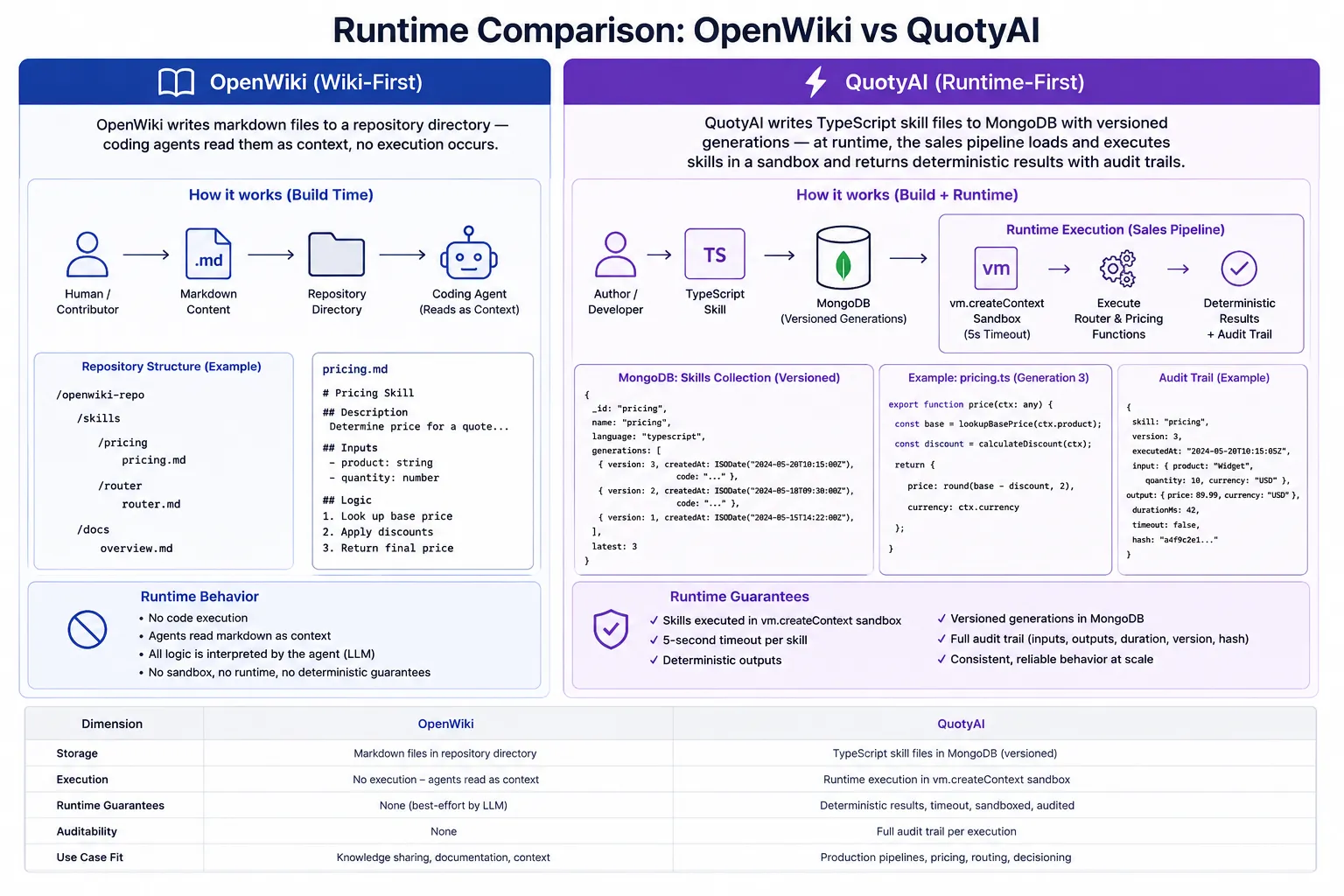
OpenWiki’s Markdown is not executed by OpenWiki. Its search tools are local and model-free; they retrieve sections for the host agent.
QuotyAI’s checkout scripts execute when the assistant handles an order. The pricing runner uses a restricted vm context, an allowlisted set of globals, and a five-second synchronous timeout.
That reduces accidental access and bounds synchronous execution. It is not a complete security boundary. The Node.js documentation explicitly says vm is not a security mechanism. High-risk or hostile code still belongs in an isolated process or container.
Error Handling: Review the Diff, Then Control the Blast Radius
OpenWiki’s natural review flow is a docs PR. Its source evidence also helps target updates instead of regenerating the whole wiki.
QuotyAI’s review flow is a workspace diff followed by a release. The owner explicitly publishes when the change should become customer-visible. Concurrent pointer updates use compare-and-swap, and rollback points to an earlier release.
Neither flow is automatic proof of correctness. A reviewer can approve a bad page. An owner can publish a bad rule. The difference is that QuotyAI keeps the execution path, the tests, and the release history close enough to investigate.
When to Use Which
Use OpenWiki when the agent needs to understand a repository, preserve architectural intent, or search across related projects. It is especially useful when the output is knowledge that humans and coding agents will consume.
Use QuotyAI when the agent needs to perform a business operation with current rules: quote, validate, check availability, or trigger a plugin. It is useful when the output needs tests, versioning, publication, and rollback.
They are not substitutes. Good documentation can help build a sales assistant. A pricing script cannot explain why the service exists. Most serious products need both kinds of knowledge.
Frequently Asked Questions
What is the difference between OpenWiki and QuotyAI? OpenWiki is an MIT-licensed CLI that creates and maintains evidence-backed Markdown documentation for codebases and personal knowledge. QuotyAI is a SaaS platform whose builder creates versioned business artifacts—catalog data, schemas, JavaScript pricing and validation scripts, plugins, and tests—that can run in customer conversations. OpenWiki’s output informs an agent; QuotyAI’s output can execute a business operation.
Can OpenWiki and QuotyAI use the same LLM providers? There is overlap, including OpenAI, Anthropic, Google, and OpenRouter. OpenWiki currently documents fifteen provider options for its standalone CLI. QuotyAI exposes configurable BYOK providers, but model and feature support still depend on the provider and integration. Adding a provider is not automatically a one-line change.
Do both projects still use createDeepAgent?
No. OpenWiki’s native CLI still uses DeepAgents. QuotyAI’s current repository uses LangChain createAgent with a LangGraph StateGraph and scoped skill editors. The two projects shared a DeepAgents design in July 2026; that is now historical for QuotyAI.
Is DeepAgents only for documentation tools? No. DeepAgents provides general-purpose agent primitives such as filesystem backends, subagents, planning, and checkpointing. OpenWiki uses them for documentation. QuotyAI’s earlier builder used them for business-logic generation. The framework does not determine whether the output is safe to execute.
What is a dependency cascade in QuotyAI’s builder?
It is the declared relationship between skills and artifacts. In the current catalog, dataCollector depends on catalog, checkout depends on catalog and dataCollector, and agentPlugins depends on all three. When an upstream artifact changes, the commit gate revalidates dependent artifacts and can block the release until the chain is consistent.
Sources
Tags: openwiki langchain langgraph agent-documentation ai-agents typescript agent-skills deterministic-ai
Related articles
Spec-Driven vs Code-First vs Chat-to-Code: Three Philosophies for Teaching AI About Your Business
How specifications, code-derived documentation, and structured conversations capture business knowledge—and where each approach still needs verification.
Read articleAI-Generated Sales Logic in Production: Six Patterns from QuotyAI's Coding Agent
How QuotyAI turns business-rule edits into versioned, tested releases—and why deterministic execution still needs validation, review, and rollback.
Read articleSelf-Hosted Agent Observability with LangChain, LangSmith SDK, and DeepAgents
How to persist LangChain DeepAgents traces in MongoDB with LangChainTracer and a custom LangSmith client — including the boundaries and operational costs.
Read article