
From Enterprise Architecture to Solo Tech Founder
What I kept from a decade in enterprise systems, what I left behind, and why I am building QuotyAI as a solo technical founder.
Okay, let’s be honest. The original headline said “15 years of solution architecture.” That was not a precise description of my career, and the opening of the post contradicted it.
At publication in April 2026, I was 34. I had spent roughly the previous decade in software, moving from junior developer to tech lead, building high-load systems, and helping teams adopt Scrum. I liked parts of it. Dynamic environments were fun. Building agile teams inside slow enterprises could be rewarding.
But somewhere along the line, I stopped building for fun.
In the years before QuotyAI, I did a lot of consulting and freelancing. Architecture diagrams. Multiple clouds. Kubernetes clusters. Message queues. Separate teams to maintain systems that already existed.
“Enterprise technology is often about mitigating risk. That is necessary—but it is not the same as building something people love.”
I still like technology: Hono, ElysiaJS, bee-queue, BullMQ. I like choosing between .NET and TypeScript. I like making things from scratch. And I dislike complexity that exists only to defend a previous decision.
I also wanted to own the upside of what I built, not just trade hours for a consulting invoice.
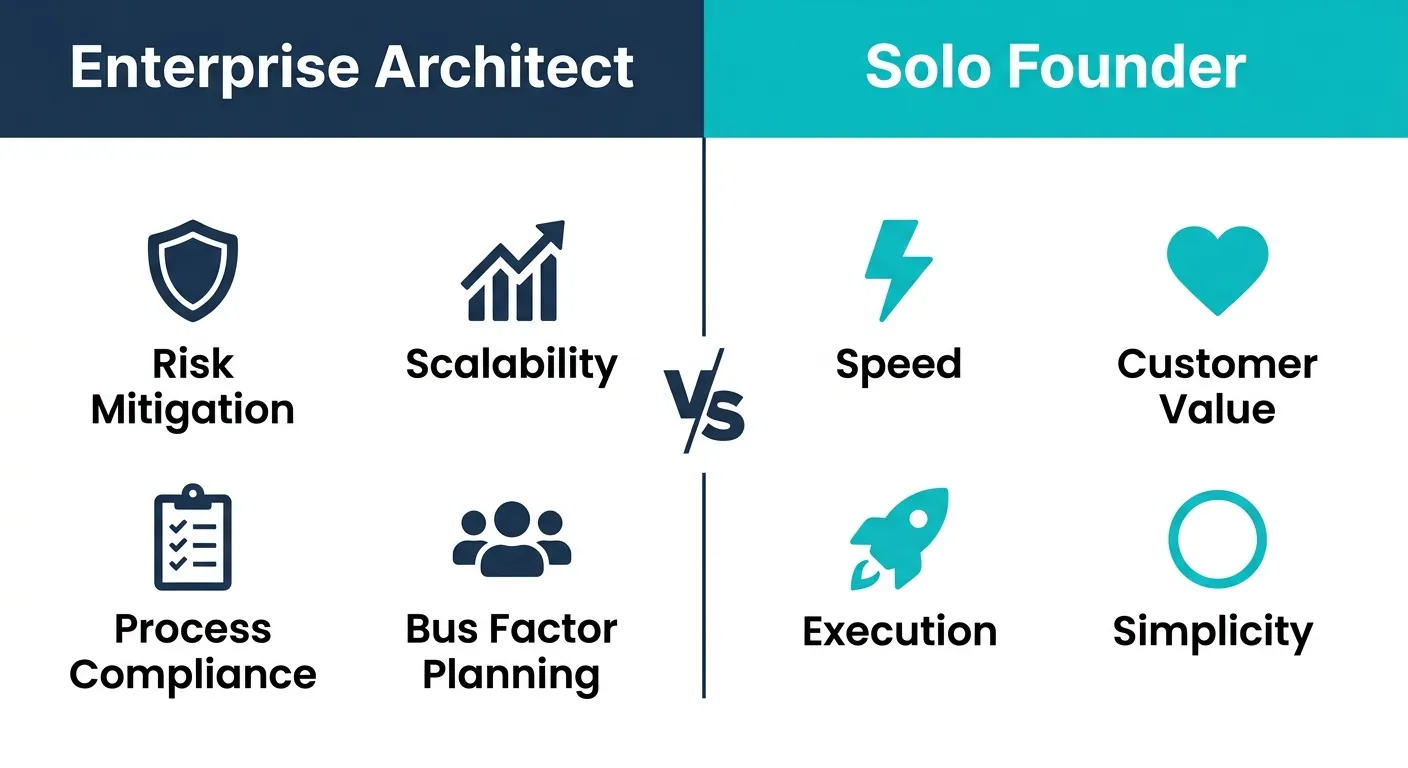
The Architect Paradox
Architects are trained to build systems that survive team turnover. That is a good instinct. It becomes a bad one when you design for problems you do not have yet.
The bus factor matters. So does the fact that no users have asked for the feature you are currently hardening.
As a solo founder, I still ask the architecture questions. I just ask: what is the cheapest decision I can reverse?
The Mindset Shift
A team of 50 may need alignment, documentation, and review because knowledge is distributed. A solo founder can make many decisions quickly because the context is in one head.
That does not make every five-minute decision good. It makes feedback and rollback more important.
I also removed the original passage about “robots interviewing robots.” Hiring is changing, and AI can screen resumes or assist interviews, but companies still need fair, job-related evaluation. Solo does not mean skipping judgment; it means doing less of the theater that does not improve the decision.
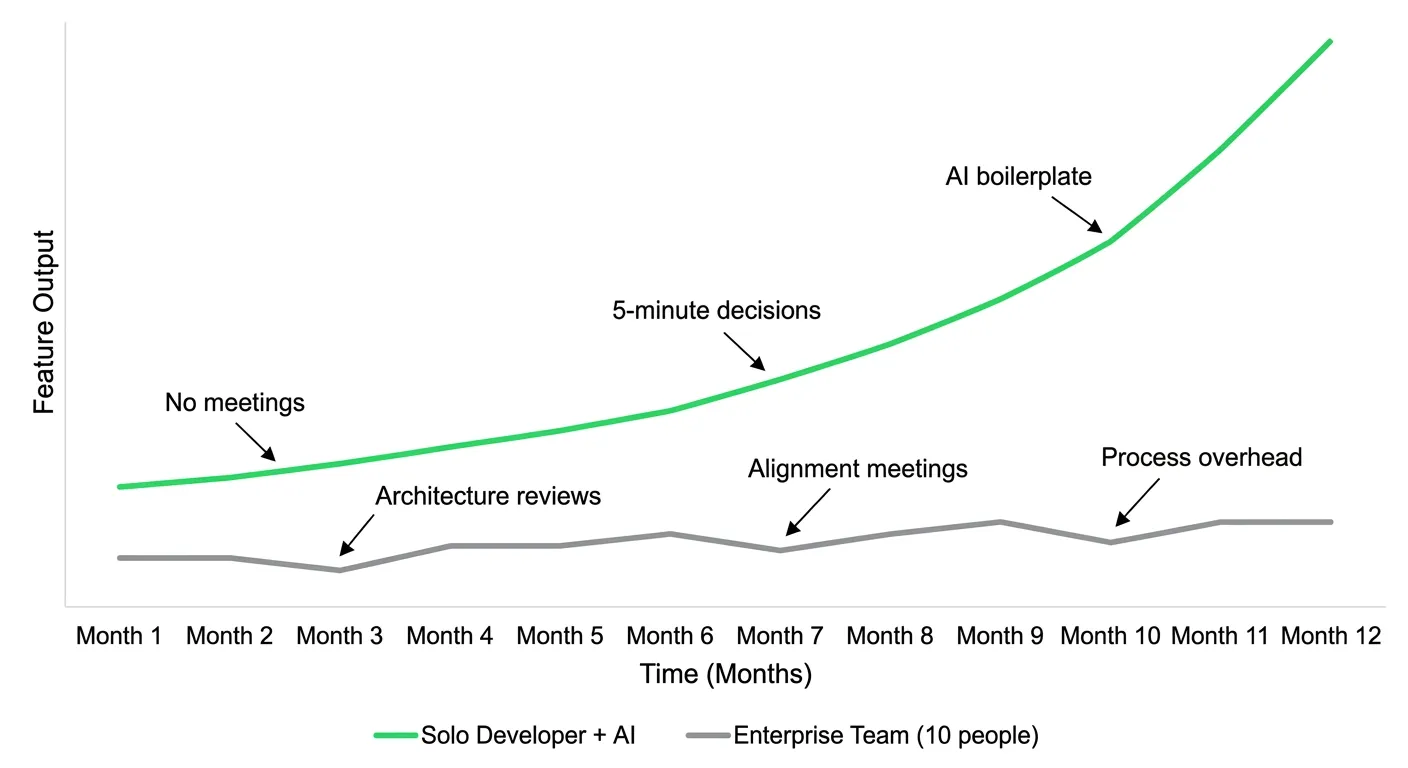
AI Changes the Work, Not the Accountability
A solo developer with good tools can move faster on a narrow task. The advantage is real when meetings and handoffs dominate the workflow.
It is not a universal law. AI can produce plausible code that is wrong, insecure, or misaligned with the requirement. It can also make a bad architecture easier to scale.
The competitive advantage is not “more people replaced.” It is removing friction while keeping review, tests, and clear ownership.
Building QuotyAI
I was the technical co-founder of Superbench, an AI sales and scheduling product for home-service companies. Iterative’s Winter 2024 batch announcement listed me as CTO.
It was a good product. I wanted to go deeper into AI—not for another demo, but for the “wow” of a system that actually does the work.
So I am building QuotyAI: a sales assistant with a shared inbox, a knowledge base, and a built-in coding agent. Instead of asking a language model to improvise a price, the system generates business-rule functions for pricing, scheduling, and order validation.
The repository implements:
- Fact extraction and schema generation
- Schema-derived TypeScript types
- Generated JavaScript pricing, scheduling, and validation functions
- Versioned releases and rollback
- Restricted
vmexecution with a timeout; Node’svmis not a complete security boundary - Human handoff and conversation history
I inspected those pieces in the local repository on November 24, 2026. The public product overview is QuotyAI.
That does not mean every reply is 100% accurate. The model can misunderstand a rule, the generator can produce a bug, and an integration can fail. The advantage is that the calculation is separated from prose and can be inspected, tested, and versioned.
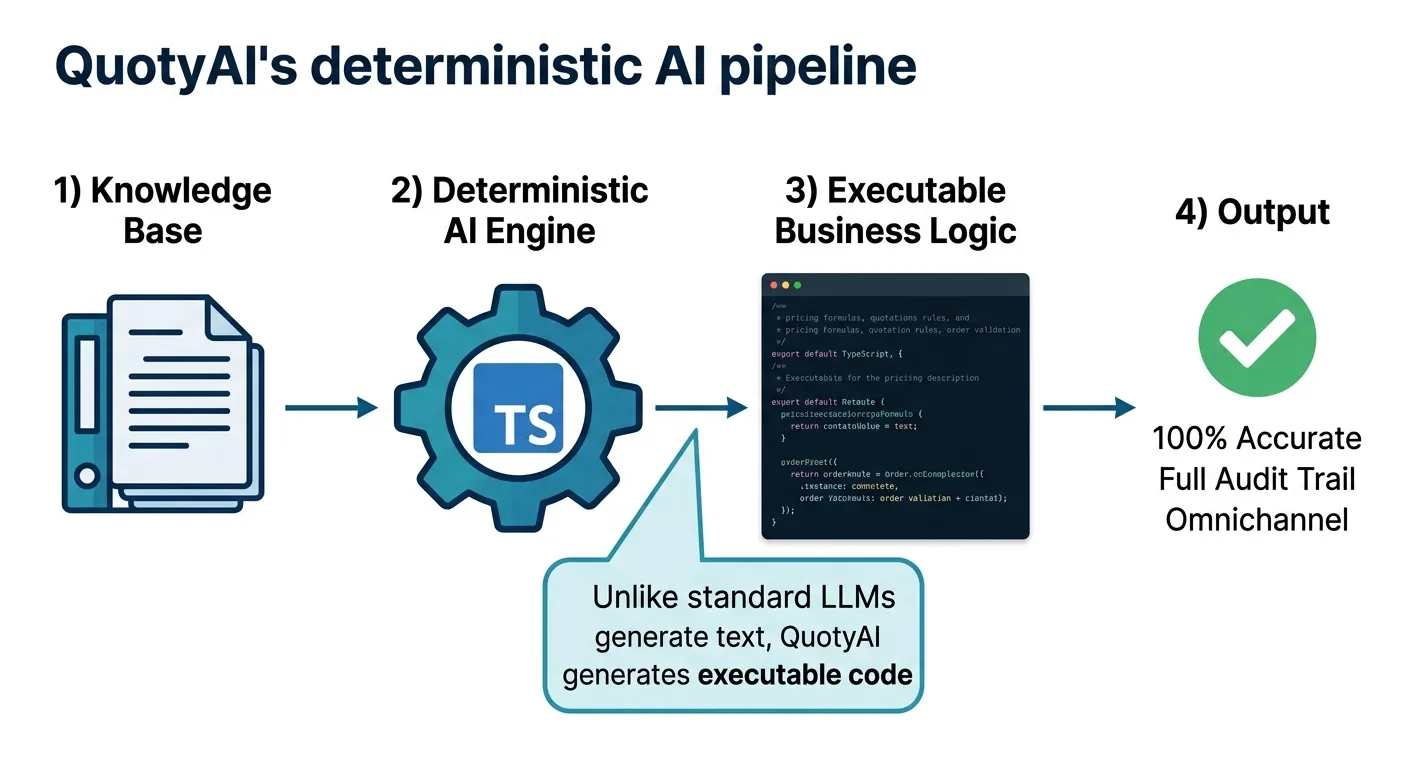
Determinism is not “AI never fails.” For a pure function, it is “the same input, code version, dependencies, and runtime environment produce the same result.”
Taking What Works, Leaving the Bloat
You do not spin up Kubernetes on day one because a diagram looks more serious with boxes.
Start with the piece of code that solves the problem in front of you. Add infrastructure when measured constraints demand it.
I still write maintainable TypeScript. I still run tests before deploy. I still define contracts. I still monitor with OpenTelemetry. I still use proven patterns like dependency injection.
What I do not do is build seven layers of abstraction for a feature used by ten people, or run a two-week architecture review for a change that can be rolled back in minutes.
“Break the wrong thing once at enterprise scale, and you learn which rules actually matter. The trick is to keep the lesson without keeping all the ceremony.”
Trading Theater for Execution
Being a solo technical founder means owning the whole loop:
- Decide what matters
- Build it
- Test it
- Ship it
- Watch it fail
- Fix it
No venture funding is required for the way I am building QuotyAI. No fake hiring theater. No endless alignment meetings. That does not mean no risk; it means the risk sits with me.
I am building for homestay owners, cafe operators, and other small businesses. They do not need enterprise bloat. They need something useful, understandable, and recoverable when it breaks.
This is the same philosophy behind building from Da Lat: less theater, more execution.
And for the first time in years, I am building for fun again.
Sources
- Iterative — Winter 2024 Batch, Superbench Founders
- Superbench Product Site
- Node.js
vmDocumentation and Security Warning - QuotyAI Product Overview
Frequently Asked Questions
Why did you leave enterprise architecture to become a solo founder?
After roughly a decade building enterprise systems, I wanted to own what I built, reduce process that did not serve the product, and return to creating for fun. I am building QuotyAI for small businesses rather than optimizing enterprise delivery for its own sake.
How does enterprise experience help as a solo founder?
It teaches which practices prevent real pain: CI/CD, observability, contracts, tests, dependency injection, and incident learning. The difference is proportionality. I no longer add seven abstraction layers or a two-week architecture review to a feature with ten users.
What makes QuotyAI different from other AI sales tools?
QuotyAI’s repository includes schema-derived TypeScript types and generated, versioned JavaScript functions for pricing, scheduling, and order validation, plus restricted vm execution and conversation history. That makes pure business-rule calculations inspectable and repeatable for the same input, code version, dependencies, and runtime environment. Node’s vm is not a complete security boundary, and language understanding or integrations can still fail. I am not making an unsupported claim that competitors lack every feature.
Can one developer really outpace an enterprise team?
Sometimes. A solo founder with good tools can avoid coordination overhead and ship a narrow change quickly. That advantage disappears when the work needs specialist depth, review, security, or operational coverage. The right comparison is cycle time for a defined task, not headcount in the abstract.
Related articles
Cheap MVPs Changed the Bar. Distribution Still Wins.
AI has made prototypes cheaper. The durable advantage is customer understanding, proprietary context, distribution, and trust—not the first working demo.
Read articleHow I Run a Production AI Startup for About $30 a Month
A dated solo-founder infrastructure snapshot: free tiers, one small VM, and the reliability tradeoffs that come with them.
Read articleThe Da Lat Digital Nomad Setup: Building a Startup From Vietnam's Central Highlands
A personal November 2026 snapshot of living costs, weather, broadband, and a simple work setup in Da Lat—plus the tradeoffs of building from a balcony.
Read article