
The Why Behind QuotyAI
A personal story about slow cross-language customer service, unreliable AI pricing, and why I put executable business logic underneath the conversation.
I like AI. Not the “write me a marketing email” AI. The AI that solves real, annoying problems that everyone else accepts as normal.
Before QuotyAI, I was in Bali trying to book a homestay. I found the place on Facebook Messenger, sent a message, and waited.
Three hours later, the reply arrived in Indonesian.
I do not speak Indonesian.
I pasted it into Google Translate, replied, and waited again. The exchange continued for three days. The room cost $20 a night.
That is the first problem I wanted to solve: a small business should not lose a customer because the conversation is slow and the two people do not share a language.
The Moment I Knew
Before QuotyAI, I worked at superbench.ai. We built vertical AI SaaS for sales and scheduling. On the AI side, we did what everyone did: RAG, prompt engineering, agent chains.
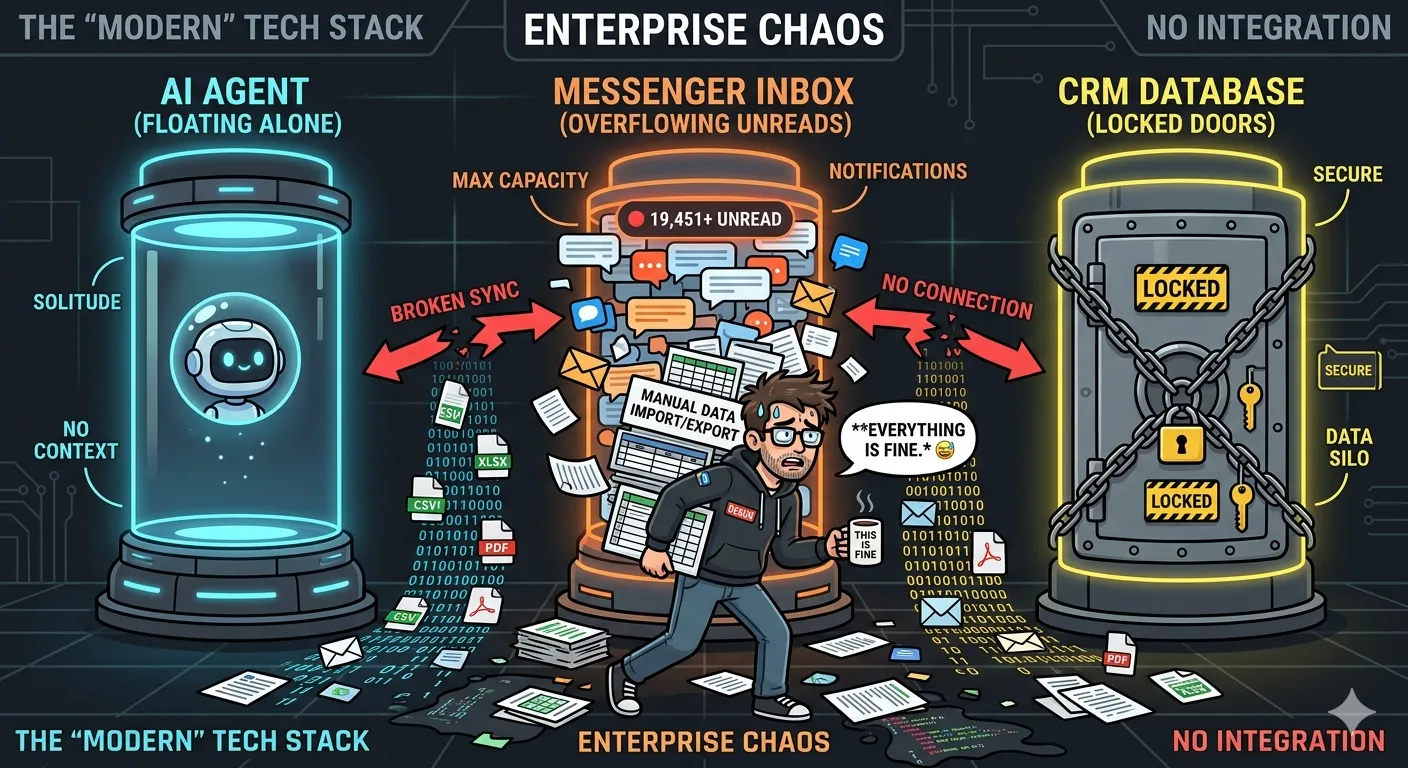
It worked often enough to demo. Then came the moment every sales demo has: someone asked the assistant to calculate a price, and the room held its breath.
Sometimes the number was right. Sometimes it was not. We treated that variance as a model problem and moved on to CRM features and integrations.
I could not stop thinking about it.
If a cash register gave the wrong change often enough, you would replace it. If an employee misquoted customers, you would correct the process. But because the mistake came from AI, “pretty good” was supposed to be enough.
I did not accept that. I also did not accept the opposite lie: that wrapping a model in the word “deterministic” makes it infallible.
What Everyone Gets Wrong
A sales assistant has to do two different jobs:
- Understand a person.
- Apply a business rule.
Language models are useful for the first job. They are not a reliable system of record for the second.
When a customer asks “how much for three nights in April?”, the answer depends on the rate, the dates, the fees, the taxes, and the promotions that are actually active. There may be one correct commercial answer, but the system has to derive it from current data.
A fluent guess is not a quote.
How QuotyAI Is Different
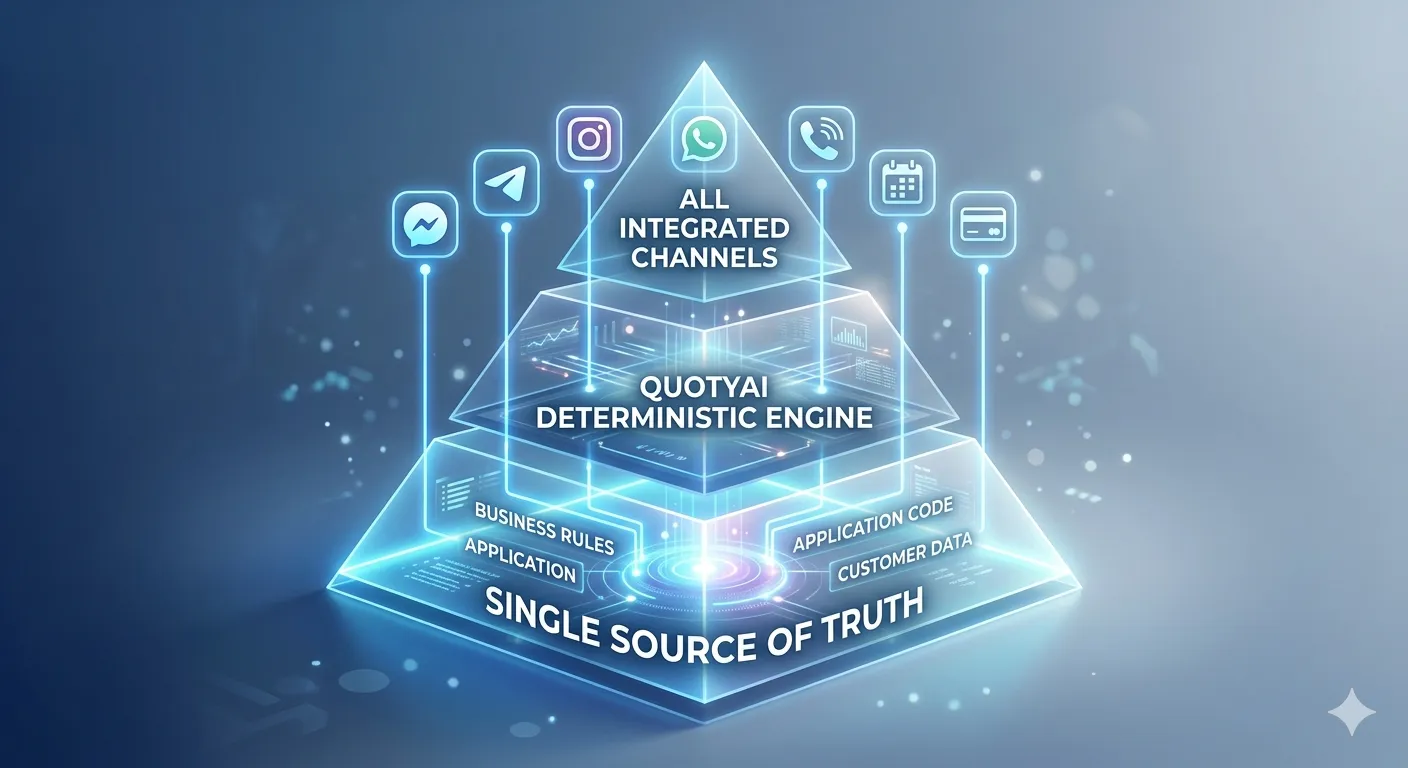
QuotyAI does not ask the model to do the final arithmetic. The owner describes the rule, the coding agent proposes executable artifacts, and the builder checks and tests them before release.
When you say “rooms are $50 a night, $20 cleaning fee, 10% off over seven nights,” the goal is not to store a sentence. The goal is a versioned pricing path that can show its inputs and its result.
That path can still be wrong. The owner can describe the policy incorrectly. The agent can generate the wrong branch. A test can encode the same mistake. The difference is that the mistake is reviewable before customers see it, and reversible after they do.
The product has three connected pieces:
- A business-rule knowledge base. Structured artifacts, not just a pile of documents.
- An omnichannel inbox. Messages, context, and human handoff in one place.
- Decision visibility. Inputs, tool calls, calculation breakdowns, and release history.
Schema-defined extraction is more reliable than freeform prose, but it is not perfect. Validation, clarifying questions, and human takeover still matter.
Why I’m Building This
I travel a lot. I work from homestays, cafes, and rented rooms. I see the same problem everywhere: the owner is trying to answer the same questions across five messaging apps while also running the business.
This is not a startup that needs a fifty-person team to prove the idea. It is a tool for solo founders, homestay operators, cafe owners, and small teams who are tired of being on-call for their inbox.
I did not start with a large market study. I started with a problem I had lived. That is not proof of product-market fit. It is a reason to build, test, and listen.
I am not building this to get acquired. I am building it because the problem kept following me from trip to trip.
What Is Shipped, and What Is Not
As of November 24, 2026, the local repository and public site show these capabilities:
- A skill builder with specialist agents, artifact contracts, tests, and versioned releases.
- Pricing, order validation, and availability scripts that run in a restricted JavaScript sandbox.
- Facebook Messenger, Telegram, Instagram, WhatsApp, Page Widget web chat, and voice.
- A Chatwoot bridge, unified inbox, conversation history, and human handoff.
- Google Calendar integration and webhook/REST API access.
- Configurable model providers and BYOK.
Those are capabilities, not guarantees. Generated code can contain bugs. External channels can fail. Extraction can miss a fact. The sandbox reduces access; it is not a complete security boundary for hostile code.
Native payment collection and deeper inventory synchronization are roadmap items, not features I am claiming as shipped. I would rather say “not yet” than turn a plan into a promise.
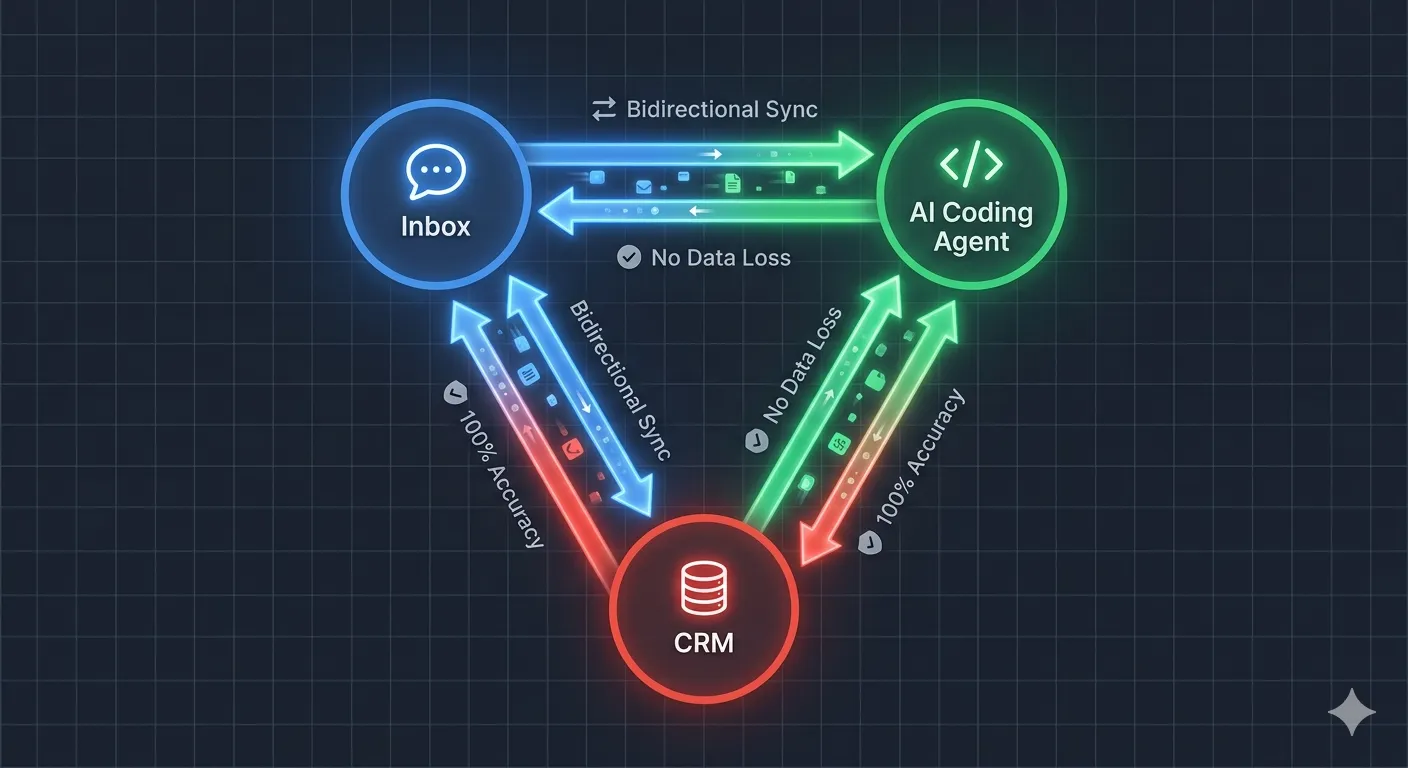
Vision diagram. The future-state label is intentional; not every component shown is shipped.
If you are tired of AI that lies. If you are tired of waiting three days for a reply. If you are tired of tools that promise the world and ship a demo.
You are in the right place.
I am building this in public. Every mistake, every win, every late coding session. You can try it for free with your own model key.
Frequently Asked Questions
Why did you build QuotyAI? I was tired of waiting days for a simple homestay reply across a language barrier, and tired of sales AI that could sound confident while getting a price wrong. I wanted a tool that combined fast conversation with explicit, testable business rules.
What platforms does QuotyAI support? QuotyAI supports Facebook Messenger, Telegram, Instagram, WhatsApp, Page Widget web chat, and voice, plus a Chatwoot bridge. Google Calendar integration supports scheduling. Exact channel availability and configuration should be confirmed for your workspace.
What is the most broken part of your customer communication right now?
Sources
Tags: AI startup deterministic AI small business solo founder
Related articles
Open Knowledge Format (OKF) vs Agent Skills
OKF organizes portable knowledge; Agent Skills package on-demand procedures and optional code. Here is where each fits — and when to query live systems instead.
Read articleDeterminism as Infrastructure
Why reliable AI agents need deterministic runtimes, explicit contracts, and verifiable completion—not just smarter models.
Read articleThe Deterministic Bet: Why I'm Building QuotyAI to Be Reliable, Not Just Chatty
Why I'm betting on tested code for business rules — and where model-generated logic still needs guardrails, review, and explicit release steps.
Read article