
The Deterministic Bet: Why I'm Building QuotyAI to Be Reliable, Not Just Chatty
Why I'm betting on tested code for business rules — and where model-generated logic still needs guardrails, review, and explicit release steps.
Every AI sales demo has the same beat.
The founder says “watch this.” They type “what’s the price for 10 users?” The AI returns a number. Everyone claps.
Nobody asks the important question: what happens when the owner says, “this customer is a friend — give them 20% off and waive the setup fee”?
Either the model invents an answer, or the demo ends with “we don’t support that yet.”
That is the gap I care about.
Update — November 24, 2026: This post was originally published on April 11, 2026. The product has moved on. This revision separates what QuotyAI currently implements from the longer-term mission, replaces absolute reliability claims, and aligns the code example with the repository’s plain-JavaScript runtime.
The Hidden Cost of Chatty AI
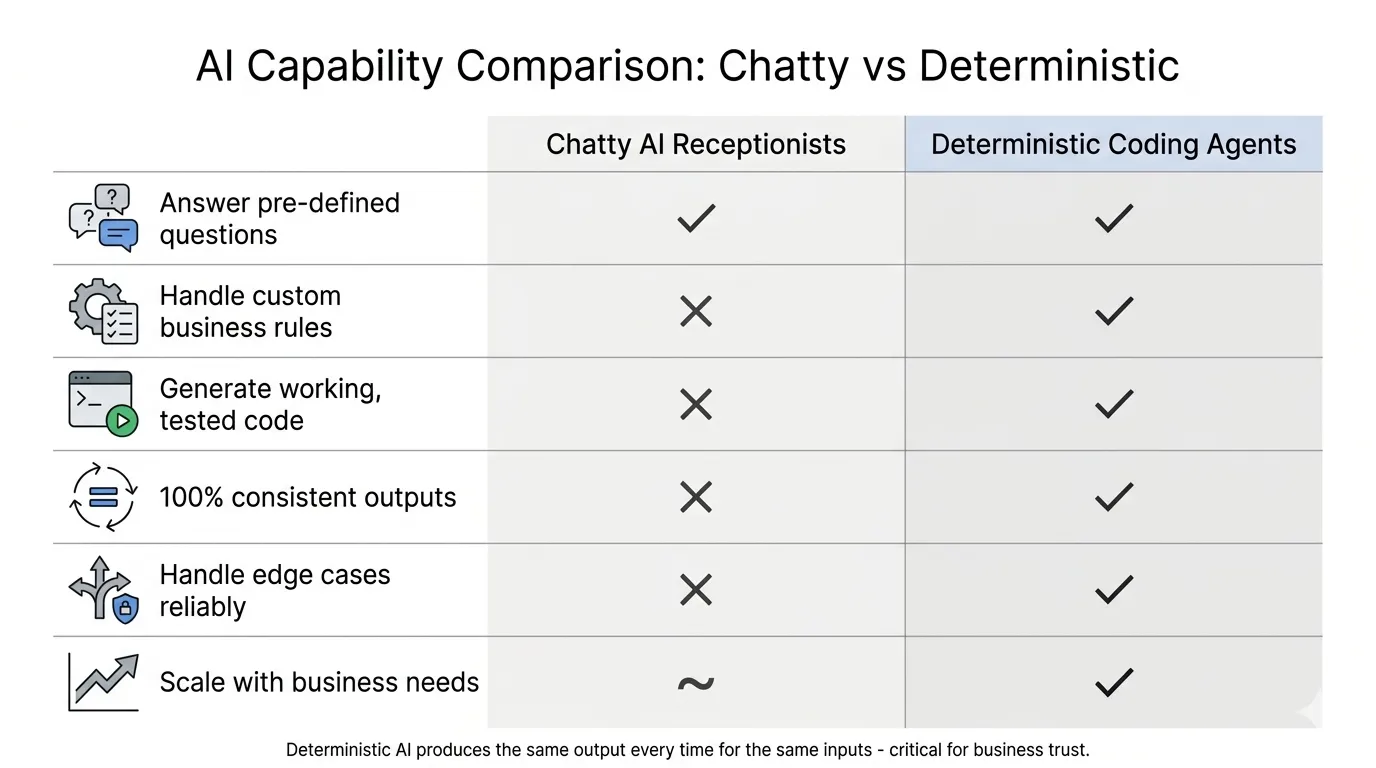
A chat-only agent can answer anticipated questions and repeat knowledge-base content. It is less dependable when a request needs a new combination of business rules.
Give a repeat customer a discount. Adjust pricing for a bulk order. Waive a fee for an upfront payment. Each rule seems simple until it collides with another rule, an invalid input, or an approval threshold.
Without explicit logic, every change becomes a prompt change, a support escalation, or a developer ticket. Larger teams can absorb that work. Small businesses often cannot.
The Coding Agent Is the Heart
Here is the bet I am making.
The most important capability of a sales assistant is not sounding human. It is turning a business decision into logic that can be checked and run.
When an owner says, “members get 15% off, and orders over $1,000 get free shipping,” the rule should not live only in a paragraph that the model may interpret differently next time.
It should become a reviewed function.
QuotyAI’s current pricing entry point is quoteOrder(catalog, variables). The runtime executes plain JavaScript, not TypeScript directly. A simplified example:
function quoteOrder(catalog, variables) {
  const order = variables.order;
  const item = order.items[0];
  const offering = catalog.offerings[item.offeringId];

  if (!offering) {
    throw new Error('UNKNOWN_OFFERING');
  }

  const basePrice = offering.durations[item.duration];
  const memberDiscount = variables.customer.member ? 0.85 : 1;
  const freeShipping = order.total > 1000;

  return {
    total: basePrice * memberDiscount,
    shipping: freeShipping ? 0 : offering.shippingFee,
  };
}
This is illustrative code, not a claim that every rule is one multiplication. Real pricing can include tiers, taxes, combinations, minimums, availability, and approval thresholds.
The point is that the calculation runs as code. The model helps author the rule; it does not improvise the arithmetic on every customer message.
“Regular Customer” Is Not a Rule Yet
The original version of this post turned “regular customers get 15% off” into customer.totalOrders > 3. That quietly invented a threshold the owner never specified.
This is exactly why intent extraction matters. Before generating code, the builder needs to resolve what “regular” means, which field proves it, and what happens at the boundary.
What Determinism Actually Means
Deterministic execution means: for the same input, code version, runtime, and dependencies, the code should produce the same result.
That is valuable for prices, discounts, validation, and approvals. It makes a calculation inspectable and testable.
It does not mean the whole system cannot fail:
- The model can misunderstand the owner.
- The generated code can encode the wrong rule.
- The catalog or order data can be invalid.
- A test can miss an important case.
- An integration can time out or return stale data.
QuotyAI’s current runner uses a restricted Node vm context, disables code generation, and applies a five-second evaluation timeout. Those controls limit behavior; they do not prove correctness.
And Node explicitly warns that node:vm is not a security mechanism. Generated code still needs review, narrow capabilities, and stronger process or container isolation when the threat model requires it.
Democratizing the Enterprise Stack
Large companies have teams that translate business rules into systems. They have analysts, developers, BI tools, and review processes.
The mission is to give a small business owner a shorter path — not to pretend the hard parts disappear.
QuotyAI currently includes:
- A skill builder for schemas, data, scripts, plugins, and tests.
- In-development and customer-visible release environments.
- An omnichannel inbox for customer conversations.
- Trace storage for model, agent, and tool runs.
- Human handoff and approval flows for orders that need them.
Structured conversations can make business data easier to query. But “How much revenue did we lose because we forgot a discount?” still depends on complete records, a clear definition of the discount, and a valid counterfactual. The system should show its evidence, not promise an exact answer to an under-specified question.
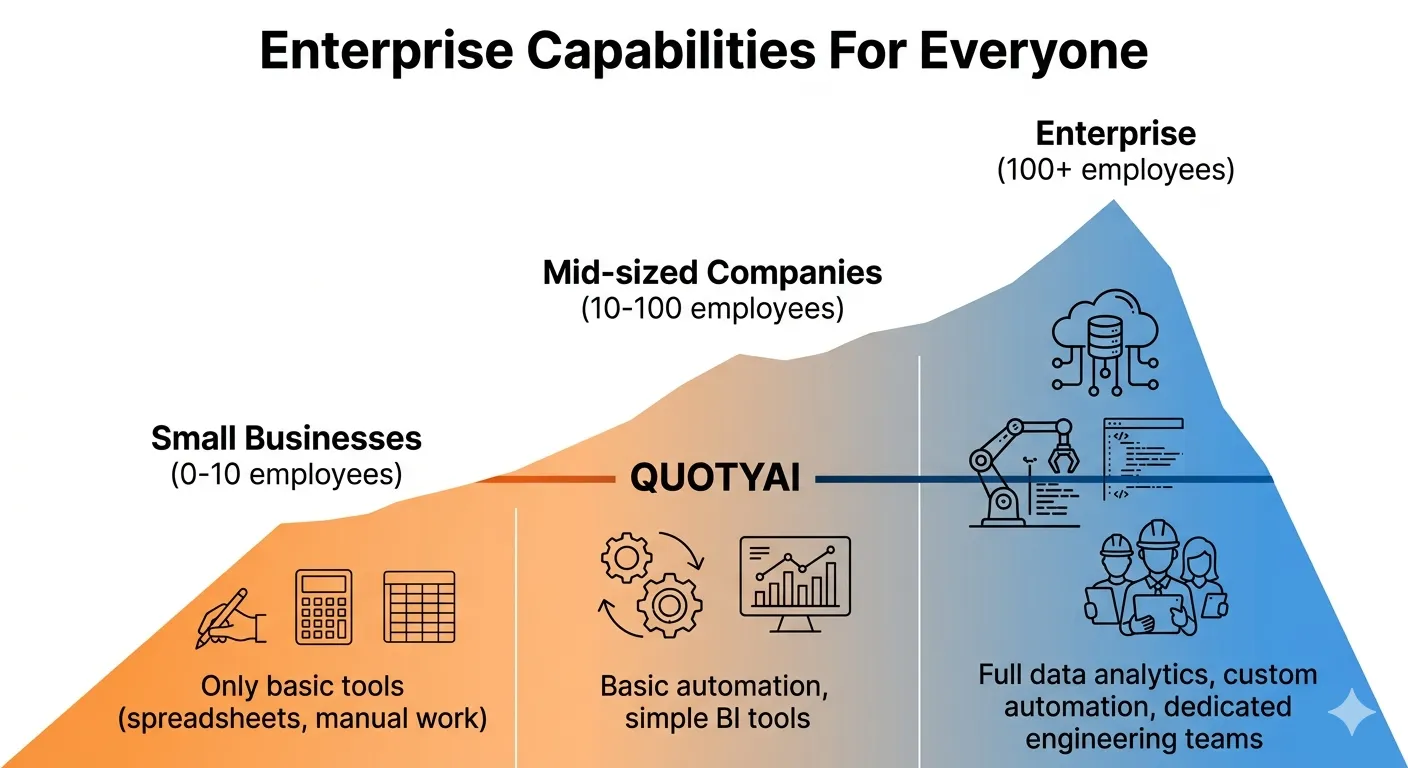
The goal is access to useful tooling. The outcome depends on the quality of the data and rules.
No More Middlemen — as the Goal
The traditional chain is:
- The owner has an idea.
- An analyst clarifies it.
- A developer implements it.
- Someone tests and deploys it.
- The owner discovers what still needs fixing.
QuotyAI is designed to compress that loop. The owner describes the change. A coding agent proposes resources. Tests and consistency checks run. A diff is reviewed. The change merges into In Development. A separate publish action makes it customer-visible.
That is not “three seconds to production.” It is a shorter loop with explicit safety gates.
For high-impact rules, keep the analyst or reviewer. For a routine price update, the owner should not need a meeting to change a number that tests can verify.
What This Means for You
If you run a small business, the practical promise is narrower than “AI does everything” and more useful:
- You can describe a rule in plain language and inspect the proposed code.
- You can test expected prices and invalid orders before publishing.
- You can keep customer conversations and business logic in one workflow.
- You can trace why a decision happened.
- You can hand a conversation to a person when the rule requires judgment.
You still need to know your business. That knowledge is the input the system cannot invent.
That’s the Bet
I am building this in public: the mistakes, the fixes, and the slow parts.
I do not think reliability comes from asking a model to sound confident. I think it comes from making decisions explicit, testing them, controlling execution, and observing what happens.
Connect your own LLM key and try QuotyAI for free if you want to see that approach in practice.
Sources
Frequently Asked Questions
How does QuotyAI handle custom business rules? QuotyAI uses coding agents to propose business resources such as schemas, plain JavaScript pricing and validation functions, and tests. Changes pass commit checks, merge into an in-development environment, and require a separate publish step before becoming customer-visible. Intent extraction and generated code can still be wrong.
What does deterministic execution actually guarantee? For the same input, code version, runtime, and dependencies, deterministic code should produce the same result. It does not guarantee that the model understood the request, that the generated rule is correct, or that external data and integrations are valid.
Why are chat-only agents unreliable for business operations? A generated answer can change when intent, context, model, or prompt changes. That is risky for prices, discounts, eligibility, and approvals. Those operations benefit from explicit rules, validation, tests, and an audit trail.
What makes QuotyAI’s approach different? The goal is to shorten the path from an owner’s rule to reviewed, tested, versioned logic. QuotyAI already includes a skill builder, release environments, an omnichannel inbox, and trace storage. Fully automatic deployment in seconds is not the current claim.
Tags: AI automation coding agents deterministic AI TypeScript
Related articles
Open Knowledge Format (OKF) vs Agent Skills
OKF organizes portable knowledge; Agent Skills package on-demand procedures and optional code. Here is where each fits — and when to query live systems instead.
Read articleDeterminism as Infrastructure
Why reliable AI agents need deterministic runtimes, explicit contracts, and verifiable completion—not just smarter models.
Read articleThe Why Behind QuotyAI
A personal story about slow cross-language customer service, unreliable AI pricing, and why I put executable business logic underneath the conversation.
Read article