
Why Gemini Chatbots Fail for Sales (And How Deterministic AI Fixes It)
Gemini chatbots hallucinate pricing because they're probabilistic. Here's how deterministic AI generates TypeScript code that calculates correctly every time.
A Gemini chatbot will hallucinate your pricing — giving customers wrong quotes, unauthorized discounts, and inconsistent numbers. The fix isn’t a better prompt or a smarter model. It’s deterministic AI: code that runs the same way every single time, no exceptions. If you’re building a sales chatbot with Gemini API, you need to separate language understanding from calculation, or you’ll bleed revenue every day.
I know this because I lived it. I built a sales and scheduling platform before QuotyAI, and the same problem kept surfacing: business owners loved how fast and natural Gemini chatbots sounded — until they realized the chatbot was quoting $650 when the real price was $680, or offering a 20% discount that didn’t exist.
The core issue isn’t Gemini itself. It’s one of the best language models available. The issue is that language models are probabilistic — they predict what an answer should look like rather than calculating it. For sales conversations, that’s a 2-8% error rate on pricing, compounded across every customer interaction.
This article explains why generic Gemini chatbots fail for business pricing, what deterministic AI actually means (it’s not just “more rules”), and how to build an AI sales agent that’s fast and accurate. We’ll look at real comparisons, the actual architecture, and why small businesses need this most.
“A chatbot that gets pricing right 95% of the time still gets it wrong 10 times a day. For a business, that’s not accuracy — that’s a liability.”
Key Takeaways
- Generic Gemini chatbots produce 2-8% pricing errors on every calculation — at 200 quotes/day, that’s 4-16 wrong prices daily
- Deterministic AI generates TypeScript code from natural language, delivering 100% consistent pricing with full audit trails
- QuotyAI responds in 24ms — 10x-40x faster than traditional LLM agent chains — while running calculations outside the LLM
- The traditional “owner to analyst to developer” workflow (6-10 days) collapses to 3 seconds with AI code generation
- BYOK with Gemini keeps total costs at $55-65/month for 500 conversations — less than one hour of a sales rep’s time
The Hidden Cost of AI Chatbot Pricing Errors
Industry estimates suggest small businesses using generic AI chatbots can lose 8-15% of potential revenue to pricing inconsistencies and unauthorized discounts. Chatfuel reports 150,000+ businesses on its platform — but probabilistic chatbot architectures mean those businesses risk inconsistent pricing instead of deterministic calculation.
What does that 8-15% look like in practice? A restaurant doing $30,000/month in quotes could lose $2,400-$4,500 monthly to wrong pricing. Over a year, that’s $28,800-$54,000 — walking out the door because the chatbot “guessed” wrong on a number.
What Happens When AI Guesses Your Pricing
I saw this firsthand before building QuotyAI. A spa owner in Da Lat set up a chatbot to handle massage bookings. The knowledge base listed $45 for a 60-minute deep tissue and $55 for 90 minutes. The chatbot interpolated $50 for 60 minutes. The owner didn’t catch it for two weeks.
During those two weeks, every 60-minute customer got quoted $50. The actual price was $45. That’s $5 per customer, times roughly 8 bookings per day, times 14 days. The business lost nearly $560 — and had to explain the discrepancy to angry customers who’d been charged more than the original quote.
That’s a simple interpolation error. The real problem is worse.
💡 Unique Insight
The real danger isn’t a chatbot that gets the price wrong once — it’s one that gets it wrong differently every time. A fixed error can be caught and corrected. A random error compounds silently across thousands of interactions, and by the time you notice, you’ve lost customers who never told you why they stopped buying.
The Revenue Leak Nobody Talks About
When an LLM handles a conversation, it doesn’t have a strict pricing function. It has a probability distribution over possible responses. A savvy customer can push the AI to offer discounts that don’t exist.
“Can you do 15% off if I book today?” — the LLM might say yes, because it doesn’t have a hard rule preventing unauthorized concessions. With deterministic pricing, the answer is always the same. The code runs, the calculation executes, and the result is $45. No negotiation. No variance. No revenue leak.
This is why every Chatfuel [1], ManyChat, and generic Gemini chatbot tutorial you find online fails for real business pricing. They’re building chatbots that sound like sales agents. They’re not building chatbots that act like sales agents.
What Makes Gemini Great (And Where It Stops)
Google’s Gemini models [2] — including Gemini 3.5 Flash and Gemini 3.1 Pro (Preview) — are genuinely impressive. The 1M+ token context window means your chatbot can hold an entire product catalog in memory. The response speed is exceptional. And with 100+ language support, you can serve customers globally without hiring translators.
Gemini 3.5 Flash specifically delivers near-instant responses, making it ideal for real-time voice chat and live conversation. The multimodal capabilities mean it can process images, audio, and text in the same interaction — a huge advantage for businesses where customers send photos of products or invoices.
The Probabilistic Ceiling
Here’s where Gemini stops being enough for sales: it’s a language model, not a calculation engine.
When you ask Gemini to “calculate the total for 3 units at $12.50 each with 8% tax,” it will likely get the right answer. But “likely” isn’t good enough for business. Research on LLM arithmetic performance [3] shows error rates between 2-8% depending on complexity — and for complex multi-step business pricing with discounts, tax rules, and conditional logic, the rates trend toward the higher end. For a restaurant doing 200 quotes a day, that’s 4-16 wrong prices daily.
The core issue is architectural: Gemini generates text token-by-token, optimizing for the most probable next word. It doesn’t “calculate” — it “predicts what a calculation would look like.” That’s fine for writing emails. It’s not fine for invoices.
Gemini 3.5 Flash and Gemini 3.1 Pro (Preview) deliver exceptional speed and 1M+ token context windows, but remain fundamentally probabilistic — they predict what an answer looks like rather than executing actual calculations. For sales pricing, this probabilistic ceiling creates a 2-8% error rate that compounds across every customer interaction.
Deterministic AI Explained (Not Just “More Rules”)
Deterministic AI doesn’t mean “no AI.” It means the AI generates executable code that runs deterministically, instead of generating text that approximates an answer.
In QuotyAI, the workflow looks like this:
- You describe your pricing in natural language — “Standard room is $80/night, suite is $150/night, 10% discount for stays over 7 nights, plus 5% tourism tax”
- The coding agent generates a TypeScript function — actual code with types, validation, and error handling
- The function executes deterministically — same input always produces same output, 100% of the time
- You get a full audit trail — every calculation has a backtrace showing exactly how the price was derived
How Code Generation Works in QuotyAI
The AI coding agent in QuotyAI isn’t just writing prompts — it’s generating production TypeScript [4]. The generated code includes:
- Type-safe pricing functions with Zod [5] validation schemas
- Complete business logic — tiered pricing, conditional discounts, add-on combinations
- Error handling for edge cases (what if the stay length is negative? what if the currency is wrong?)
- Audit trails — every calculation logs its inputs, logic path, and output
This is fundamentally different from asking Gemini to “calculate the price.” The Gemini model does the creative work of understanding your natural language description and translating it into code. Then the code does the actual work of calculation — deterministically, every time.
💡 Unique Insight
The coding agent isn’t writing code for developers to review. It’s writing code for the business owner to approve. The TypeScript is there for type safety and auditability — but you never need to read it. You describe the rule, the system runs it. That’s the real unlock.
“Deterministic AI isn’t about removing the model. It’s about knowing exactly when to ignore it.”
From Natural Language to Production in 3 Seconds
The entire pipeline — from you describing your business rules to having a working, tested, deployed pricing function — takes about 3 seconds. Compare that to the traditional workflow:
| Step | Traditional | QuotyAI |
|---|---|---|
| Understand requirements | 1-2 days (analyst) | 3 seconds (AI agent) |
| Write pricing logic | 3-5 days (developer) | 3 seconds (code generation) |
| Test and validate | 1-2 days (QA) | Automatic (type system) |
| Deploy to production | 1 day (DevOps) | Instant (sandboxed runner) |
| Total | 6-10 days | 3 seconds |
The old way requires an owner to explain requirements to an analyst, who writes a spec for a developer, who writes code, which gets tested, and finally deployed. That’s a chain of human communication where meaning gets lost at every step.
QuotyAI collapses this into one step. Your natural language becomes production code directly.
Deterministic AI generates TypeScript code from natural language business rules in 3 seconds — collapsing the traditional 6-10 day owner-to-analyst-to-developer chain into a single step. The generated code is type-safe, auditable, and executes identically every time, eliminating the probabilistic errors inherent in LLM-only approaches.
Generic Chatbot vs Deterministic AI: A Side-by-Side Comparison
Let’s compare what happens when a customer asks a chatbot for a quote in both approaches.
Scenario: A real estate agent’s chatbot receives a request: “What’s the monthly rent for the 2BR apartment on Nguyen Hue Street, available from June 15?”
Generic Gemini Chatbot Response
The LLM searches its knowledge base, finds the listing, and generates a response. It might say:
“The 2BR apartment on Nguyen Hue Street is available from June 15. Monthly rent is $650. It includes parking and utilities.”
But the actual rent is $680 with a $30 move-in promotion for June. The LLM missed the promotion because it wasn’t in the training data prominently, or it interpolated incorrectly.
Deterministic AI Response
The AI agent identifies this as a pricing query, routes it to the generated pricing function, which executes:
function calculateRent(propertyId: string, moveInDate: Date): Quote {
  const baseRent = getPropertyRent(propertyId); // $680
  const promotion = getActivePromotion(propertyId, moveInDate); // -$30 June promo
  const utilities = getUtilitiesIncluded(propertyId); // $0 (included)

  return {
    monthlyTotal: baseRent + promotion + utilities, // $650
    breakdown: { baseRent, promotion, utilities },
    auditTrail: { /* full calculation path */ }
  };
}
The response is identical to the generic one in this case — but it’s guaranteed to be correct, every single time, with a full audit trail showing exactly how $650 was calculated.
What Auditors and Business Owners See
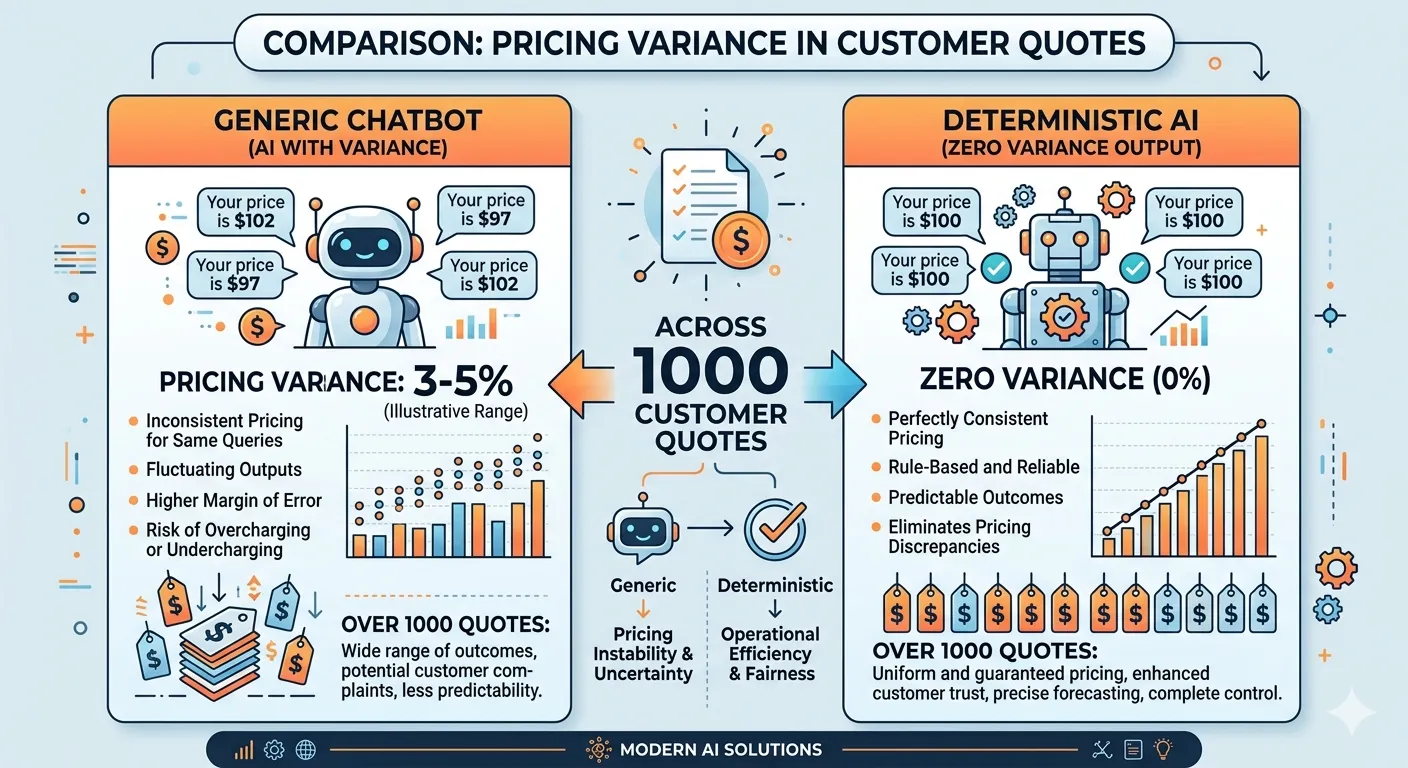
The difference becomes critical at scale. After 1,000 conversations:
- Generic chatbot: Some quotes are $650, some are $680, some might be $620. Average variance: 3-5%. Revenue impact: significant.
- Deterministic AI: Every quote for this scenario is exactly $650. Variance: 0%. Revenue: predictable and auditable.
After 1,000 conversations, a generic Gemini chatbot produces 3-5% pricing variance across quotes for identical requests. Deterministic AI maintains 0% variance with full audit trails. That’s not a marginal improvement — it’s the difference between a chatbot that might help your business and one you can actually trust with money.
Building an AI Sales Agent with Gemini + Deterministic Logic
The architecture that makes this work isn’t complicated. It just requires one key decision: separate the LLM from the math.
The Architecture
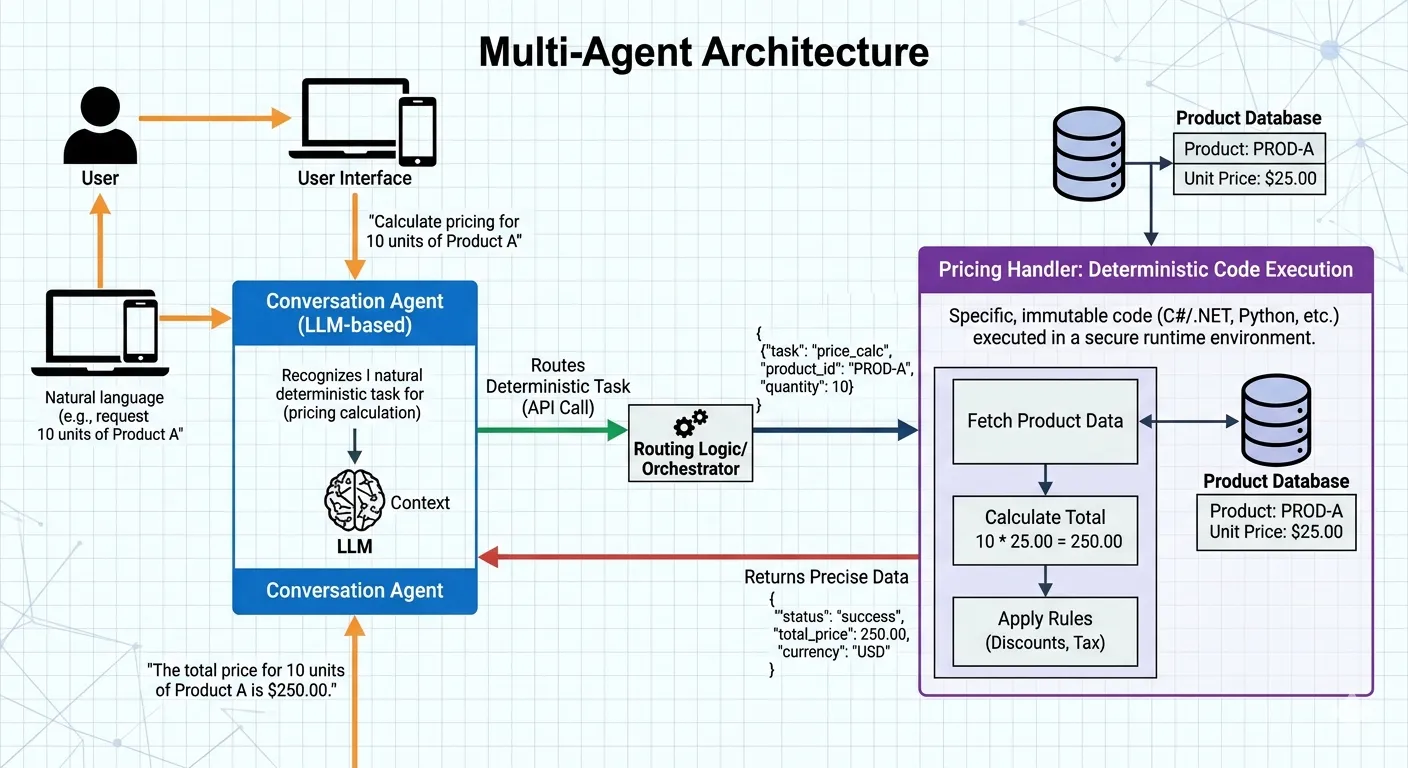
QuotyAI uses a multi-agent orchestration system:
- Conversation Agent (Gemini 3.5 Flash or Gemini 3.1 Pro) — handles natural language, understands intent, speaks 100+ languages
- Coding Agent — generates TypeScript business logic from your natural language descriptions
- Pricing Handler — executes the generated code deterministically, bypassing the LLM entirely for calculations
- Omnichannel Router — routes conversations from WhatsApp, Telegram, Facebook, Instagram, voice calls, and Chatwoot into the same pipeline
The Conversation Agent never sees the pricing logic. It identifies the customer’s intent (“this person wants a quote for a 2BR apartment”), calls the Pricing Handler, and the handler runs the pre-generated TypeScript function. The LLM does the thinking. The code does the math.
I explain this philosophy in more detail in my post about the deterministic bet. Why does this matter? Because when you ask Gemini to calculate 3 units at $12.50 each with 8% tax, it gets it right most of the time. But when you ask it the same question twice, it might return $40.50 once and $40.49 the next time. The difference is tiny. But in a business where you’re doing 500 calculations a day, those tiny differences compound into thousands of dollars of variance.
The deterministic Pricing Handler doesn’t have this problem. It’s TypeScript code with type-safe Zod validation schemas. Every input gets validated. Every calculation follows the exact same code path. Every output includes a complete audit trail. No variance. No guessing. No “probably right.”
💡 Unique Insight
The gap between enterprise AI and small business AI isn’t talent — it’s plumbing. Big companies have engineers who connect language models to business logic. QuotyAI eliminates the need for that plumbing entirely, giving a solo cafe owner the same deterministic accuracy that Fortune 500 companies pay millions to achieve.
BYOK Cost Control
QuotyAI supports Bring Your Own Key (BYOK) — you connect your own Gemini API keys from Google AI Studio [6]. This means:
- You pay Google directly for token usage (Gemini models like 3.1 Flash-Lite start at just $0.25/1M input tokens)
- QuotyAI charges a flat $50/month for the platform
- No markup on tokens — you get Google’s pricing without a middleman
- Full control — rotate keys, set usage limits, monitor costs in Google Cloud Console
For a business doing 500 conversations per month, the total cost breaks down to roughly $50 (QuotyAI) + $5-15 (Gemini tokens) = $55-65/month. Compare that to hiring a developer to build custom chatbot logic ($5,000-20,000 upfront) or paying a SaaS chatbot platform $69-150/month for less functionality.
QuotyAI also supports BYOK for other major LLM providers — GPT-5.5, Claude Sonnet 4.6, and DeepSeek 4 Pro. You’re not locked into Gemini. If a better model comes out next quarter, you swap your key and your entire sales agent upgrades instantly.
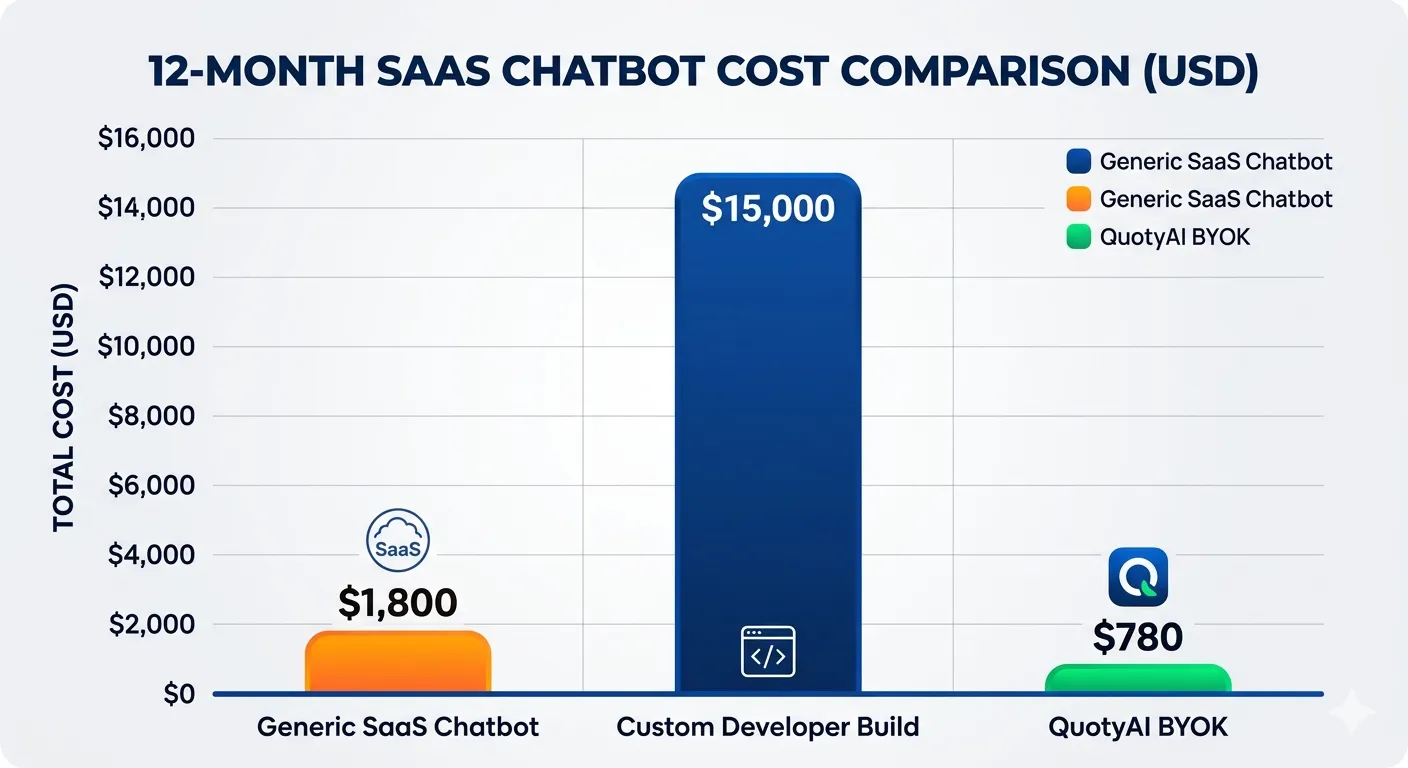
QuotyAI’s architecture separates language understanding (Gemini API) from calculation execution (deterministic TypeScript code), ensuring the LLM never touches pricing math. With BYOK support, businesses pay $50/month to QuotyAI plus Google’s token rates — typically $55-65/month total for 500 conversations — and can swap between Gemini, GPT-5.5, Claude Sonnet 4.6, or DeepSeek 4 Pro at any time.
Why Small Businesses Need Deterministic AI Most
Enterprise companies can afford to build custom AI solutions with dedicated engineering teams. Small businesses — the homestay owner, the cafe operator, the restaurant owner — can’t.
Before QuotyAI, these businesses had three bad options:
- Do nothing — answer messages manually, losing customers who don’t want to wait 3 hours for a reply
- Use a generic chatbot — fast but inaccurate, risking pricing errors and customer trust
- Hire a developer — expensive ($5,000-20,000), slow (weeks to months), and requires ongoing maintenance
Deterministic AI with Gemini eliminates option 3 while fixing option 2. The business owner describes their rules once (“standard room $80/night, suite $150/night, 10% discount for 7+ nights”), the AI generates the code, and the system runs autonomously — with the accuracy of a custom solution and the affordability of a chatbot builder.
I built QuotyAI after a specific experience: I was traveling in Bali and needed a $20/night homestay. The owner’s response time was three days for a simple availability question. Not because they didn’t want to help — because cross-language communication was broken. The owner spoke Bahasa Indonesia, I spoke English, and the messaging gap meant a $20 booking took 72 hours of back-and-forth.
That’s the problem QuotyAI solves. Not just faster chat. Not just AI that sounds human. But AI that understands your business rules and applies them consistently, across any language, on any channel, 24/7.
Democratized Enterprise Data
Beyond pricing, QuotyAI provides analytics that were previously only available to companies with data teams. Business owners can ask questions like “How much revenue did we lose from unapplied discounts last month?” and get a real answer — because the system has a complete, deterministic record of every transaction.
This is the democratized enterprise data thesis in action: big-company capabilities, accessible to a solo entrepreneur paying $50/month. No BI tools. No data analysts. Just ask your AI in plain English and get the numbers.
“The best sales agent doesn’t sound smart — it sounds certain.”
Pricing Error Impact at Scale
Here’s a visual summary of what deterministic accuracy means for your bottom line:
Frequently Asked Questions
Can I use Gemini API to build a sales chatbot?
Yes, but not reliably on its own. Gemini API provides excellent language understanding and conversation handling, but it’s probabilistic — meaning it can hallucinate pricing and business logic. To build a reliable sales chatbot, you need deterministic code execution alongside Gemini’s language capabilities. Platforms like QuotyAI use Gemini for conversation while executing generated TypeScript code for all calculations, ensuring 100% accuracy.
What is deterministic AI vs probabilistic AI?
Probabilistic AI (like ChatGPT, Gemini, Claude) generates responses based on probability distributions — it predicts what an answer should look like. Deterministic AI generates executable code that runs the same way every time — same input always produces the same output. For business applications like pricing and order validation, deterministic AI is essential because you need guaranteed accuracy, not probable accuracy.
How do I make an AI chatbot give accurate pricing?
The most reliable approach is to separate language understanding from calculation. Use an LLM like Gemini for conversation and intent recognition, but route all pricing queries to generated TypeScript functions that execute deterministically. This way the chatbot sounds natural but calculates with 100% accuracy. QuotyAI automates this entire pipeline — describe your pricing in English, and production code is generated instantly.
Why do Chatfuel and ManyChat chatbots give wrong prices?
Chatfuel and ManyChat use generic LLMs for all responses, including pricing. Since LLMs are probabilistic, they can produce slightly different answers for the same question. They also lack hard-coded business rules — there’s no mechanism to prevent an AI from offering unauthorized discounts. Deterministic platforms solve this by executing actual code instead of generating text.
Can I bring my own Gemini API key to QuotyAI?
Yes. QuotyAI supports BYOK (Bring Your Own Key) for all major LLM providers including Google Gemini, GPT-5.5, Claude Sonnet 4.6, and DeepSeek 4 Pro. You connect your keys from Google AI Studio, pay Google directly for tokens, and QuotyAI charges a flat $50/month for the platform. No markups on token usage, full cost control, and you can rotate or revoke keys anytime.
The Bottom Line
Gemini is the best foundation for building a sales chatbot — fast, multilingual, and affordable. But without deterministic code execution, it’s a conversation machine pretending to be a sales machine. The hallucination problem isn’t a bug to be patched; it’s a fundamental architectural limitation of probabilistic models.
Deterministic AI fixes this by using Gemini for what it’s great at (understanding language, handling conversation, speaking 80+ languages) while generating TypeScript code for what requires precision (pricing, order validation, scheduling rules). The result is a chatbot that’s as fast and natural as a Gemini-powered assistant, but with 100% consistent, auditable, production-grade accuracy.
If you’re building a sales chatbot with Gemini and you need it to actually close deals — not just chat — deterministic code generation isn’t optional. It’s the difference between a fancy autocomplete and a real sales agent.
Ready to see it in action? Connect your Gemini API key to QuotyAI for free and build your first deterministic sales agent in minutes.
External References
Found this useful? Share it.
Related articles
Executable Skills for Agents Are Better Than Docs
Documentation was built for humans. Now AI agents read it. They don't need prose — they need executable code. Why skills beat documentation.
Read articleSpec-Driven vs Code-First vs Chat-to-Code: Three Philosophies for Teaching AI About Your Business
Three approaches to building AI agent knowledge — spec-driven development, code-first documentation, and chat-to-code generation. A comparison of Spec Kit, OpenWiki, Mintlify, and QuotyAI with real pitfalls, products, and convergence signals.
Read articleOpenWiki vs QuotyAI: Two LangChain DeepAgents Projects, Two Architectures
OpenWiki uses LangChain DeepAgents to generate agent documentation for codebases. QuotyAI uses the same createDeepAgent API to generate executable TypeScript business logic. A technical comparison of agent architecture, subagent patterns, and runtime execution.
Read article